
Looking ahead, I want my giving to go beyond money and extend into how I show up for people and communities. I hope to continue offering my time and skills to organizations that create access, equity, and joy for others, especially for children and people with disabilities. I want my giving to be rooted in connection, whether that’s through volunteering in direct service, using my education to strengthen nonprofits, or building relationships that inspire others to give as well. Financially, I plan to give what I can at each stage of life, starting small but consistently, with the hope that one day I can commit larger gifts that support causes I care about for the long term.

What is a Giving Goal?
Often, the idealism of youth is lost as one achieves success and acquires material possessions later in life. What was originally considered to be “enough” or even “beyond my wildest dreams” can become just another milestone on one’s quest…
Capturing your current vision of how you wish to give of yourself and your resources in the future could help you plan to give more meaningfully. Revisiting this vision in ten or twenty years could provide a reminder of the ideals of your youth that may shape or re-shape your future actions.
If you have already posted your Giving Goal and would like to update your email for future reminders, please contact [email protected]
Step 1
Have a healthy and vigorous dialogue in your class on the general idea of having a personal Giving Goal as a college student.
Step 2
Set a Giving Goal concerning your future giving plans.
Step 3
Share a brief statement of your Giving Goals on The Philanthropy Lab’s portal as a way to inspire others to do the same. You may post anonymously to the public if you wish.
Step 4
Share your permanent email address and phone number with The Philanthropy Lab, for the sole purpose of the reminder mechanism, so we can remind you of your goal in 5 year increments for 20 years into the future.
Alumni Reflections
Baylor Alum
"What a sweet reminder of this pledge! I've definitely given and volunteered in the last 6yrs. It's been a joy to continue the journey of generosity since graduating from undergrad. I'm back in grad school and I am looking forward to finishing my MSW. There will be new ways I give back to the community!"
Columbia Alum
"Thank you so much for this valuable reminder of my Giving Pledge. I'm proud to say I've dedicated several hours of volunteer time & services to Arts Education non-profits and will continue to live out this pledge"
Harvard Alum
“Thanks for reaching out––I'm actively still volunteering at two non-profits now in NYC (one free food service called "Wellfare" and a neighborhood homeless shelter)”
Wisconsin Alum
"Thank you for your email! The Philanthropy Lab was a life changing experience for me. I ended up joining the board of Malawi Children's Village to run the women empowerment program, which is what the Philanthropy Lab grant was for. In August, I am going to Malawi to see the project in action!"
UT Alum
"I was so happy to see this email pop into my inbox, it feels like a lifetime ago I was in this course. I appreciate all that I learned in this class and have taken its messages with me through these past 5 years. I do plan on maintaining the promise I made in this class"
Baylor Alum
"Thanks for this reminder. I actually still have a handwritten version of that note on the magnet board in my home office."
Search for Giving Goals
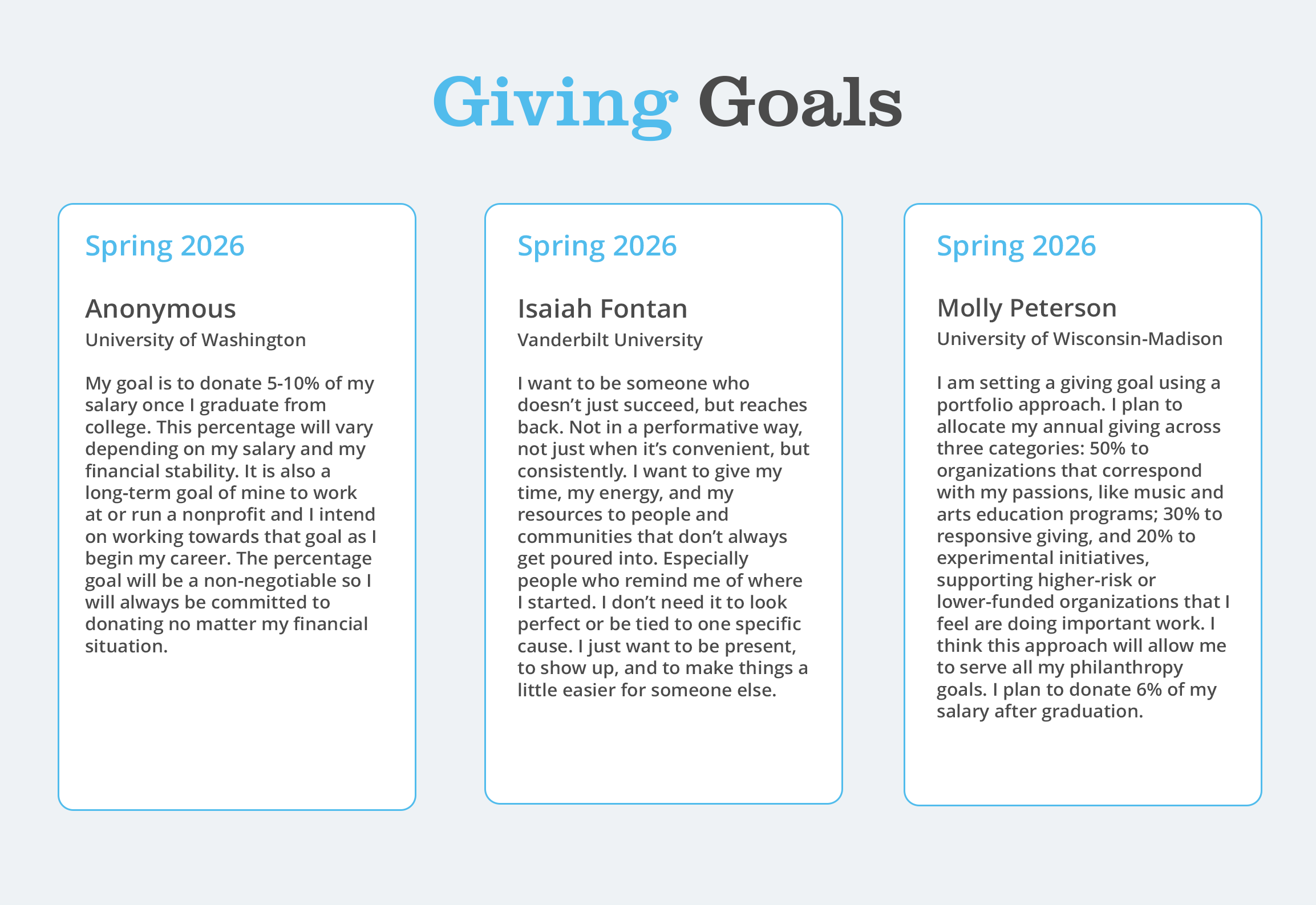
Over 4,200+ course participants have written giving goals in a demonstration of leadership!
Anonymous
- Fall
- 2025
My long-term giving goal is to commit 1% of my annual income and 50 hours of volunteer service per yer to causes related to international human rights and disability advocacy. I will revisit this goal each year to make sure it aligns with my values and capacity.
Anonymous
- Fall
- 2025
I want to give 5% of my salary to charity and volunteer my time two days a year, especially around holiday time.
Anonymous
- Fall
- 2025
I commit to giving 5% of my income while in University.
Anonymous
- Fall
- 2025
My Giving Goals Passion for Changing the World: I want to respond to the issues of inequality and make it so everyone gets the same opportunity. I want to especially support women and those that are poor and of color. I want to create awareness of and empathy for the issues, and change how people treat each other for the better. What I Think will Help Change the Issues I Care Most About: Education, advocacy, and mentorship will help make a difference. I believe providing people with the knowledge, self-confidence, and support of a community will help break the inequality in society. Justice-orientated, inclusive and accessible policies are other significant elements of enduring change. What I Am Currently Doing or Plan to do Through My Giving: I want to help with community outreach programs by volunteering and by mentoring young girls that I can encourage to help them to set and achieve goals. I plan to spend time with and help local charities that are focused on helping the poor and support racial and gender equality. Over the next 5–10 years, my goal is to possibly one day start my own non-profit, one that offers support for things I am most passionate about. Letter to My Future Self Dear Future Me, As you continue to stay true to your values of compassion, justice, and equality, I hope you reflect on why you started. I know you were in the position to help and chose to do so. You were and continue to help people from hurting. It is hoped that you have volunteered, mentored, and advocated for the change. I trust you have given your time to causes of education, and of women’s and community development. I hope you have made an impact and inspired others with your gifts! Never walk away from the causes that account for the most like anti-poverty, equality, and equity. Continue to give to the trusted organizations within a % of your income that you feel is meaningful, I suggest around 5-10%. Stay positive and keep your heart open. Remember, it’s important to have faith that everything you do makes a difference. Real change doesn’t happen all at once. With every little step you take, you contribute to a world that is kinder and more caring. With all my hope, Alexia
Anonymous
- Fall
- 2025
My giving goal is to be able to spend some amount of time each week doing volunteer work for a non-profit I support (e.g. teaching in the Petey Greene program) and/or to offer some of my educational services to high-need, low-income school districts and individuals for low-to-no cost. While I may one day earn a high enough income, and find an organization that I trust to put my donation towards what I think needs that support most, that I will decide that my money would make the most impact out of my hands, that day is far off and uncertain. However, if I am able to successfully found and maintain a business or non-profit providing consulting services, trainings, and resources to institutions in special education, I would put aside some of my organizations revenue from our paying partners to afford the provision of these supports to institutions that are unable to afford our rates. Doing more volunteer work is something that I hope to achieve in the more near future, as the only requirement for doing so is a few hours, ideally 5-10 eventually, a week of time and effort. I mentioned the Petey Greene program because I work in education and have always believed that the high rates of incarceration throughout the US are deplorable and do much more long-term harm to society than most people acknowledge. Being able to provide incarcerated or formerly incarcerated individuals with the opportunity to learn new career skills and support them in their transitions back into “free society” would not only be personally-gratifying, but would help to rectify some of the harm these people have suffered at the hands of a corrupt institution. Overall, I think that I will be able to do more good organizing initiatives like the Petey Greene program than in participating in them, but as an overworked college student, educator, and researcher, participation is more within my current capacity for time.