
As TCU students, we hope to build upon the school’s mission and become ethical leaders in our community. Through the Nature of Giving course and the advice of guest speakers like the Jeff and Kelly Dillard, Ed Schollmaier, and John Robinson, we have learned of the importance of investing in our community through providing financial support, giving time and labor, and sharing our own expertise and passions. As the 2016 Nature of Giving class, we commit ourselves to giving our time and finances, while maintaining the mindsets of givers throughout our lives. Therefore, I pledge to donate 5% of my monthly personal income to a cause(s) of my choosing. I pledge to practice responsible philanthropy by conducting due diligence before giving to an organization. In addition to financial support, I commit myself to volunteering with organizations in order to foster personal relationships in the community. I will work to better the local and/or international community by establishing at least one partnership with a charitable organization. In order to remain actively engaged, I will review my donations and involvement annually. (I am choosing to sign the class giving pledge because I believe that it encompasses all of the main points that were important to me when we were creating the giving pledge in class, including the influence and advice of the Dillards (especially finding what you are passionate about and the idea of setting aside the money in a separate account), not only giving money but also time, and reviewing the donation annually. After graduation, I will be interning with a non-profit organization for the summer, so I feel that my time will be very dedicated to the community. Because this is an internship, though, and I will be getting a small monthly stipend, I am choosing to start my giving at 5% right now. I hope to increase this as the months go on, and will review where I am financially after the internship, when I am in a full time job, and annually after that.)

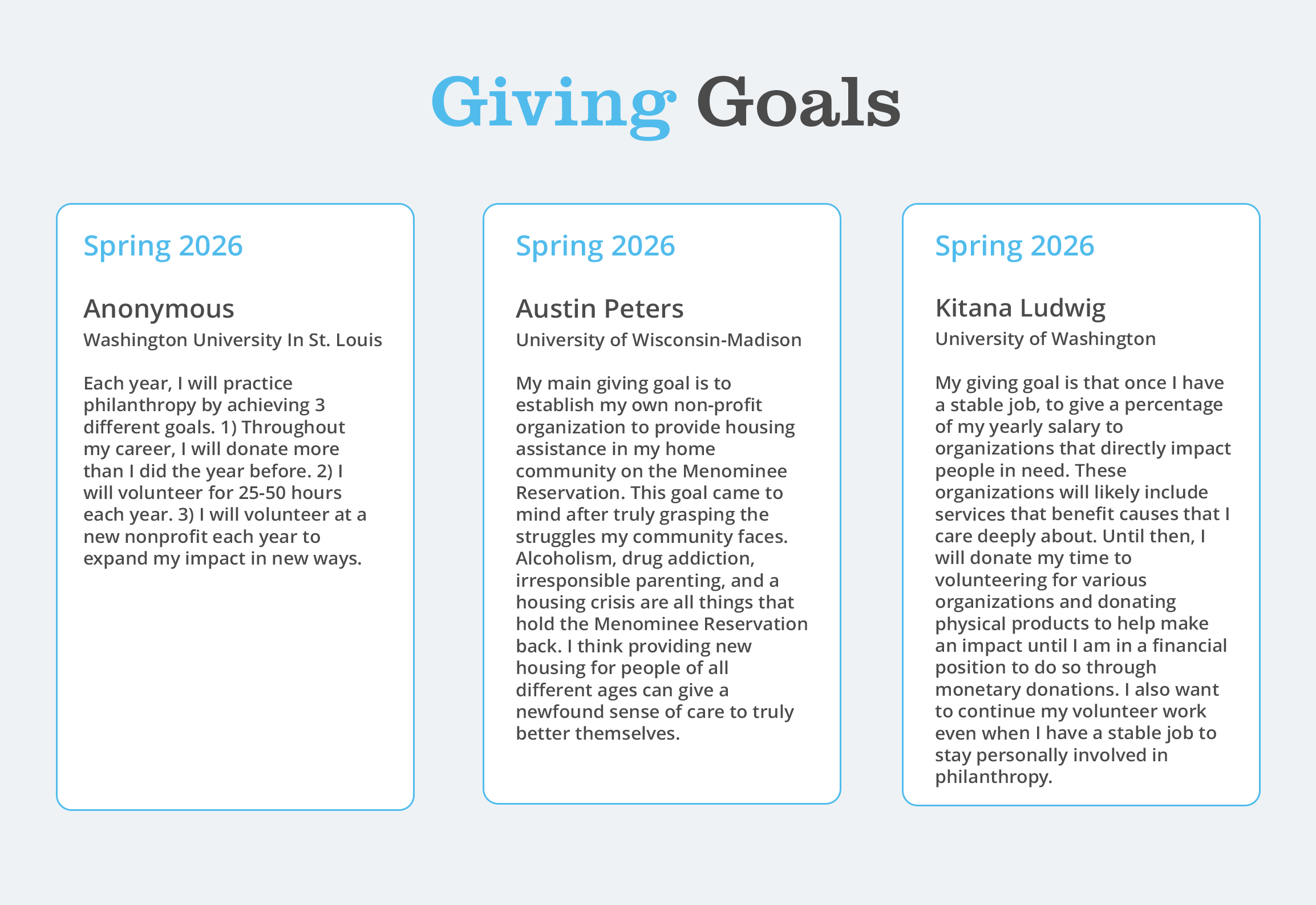
What is a Giving Goal?
Often, the idealism of youth is lost as one achieves success and acquires material possessions later in life. What was originally considered to be “enough” or even “beyond my wildest dreams” can become just another milestone on one’s quest…
Capturing your current vision of how you wish to give of yourself and your resources in the future could help you plan to give more meaningfully. Revisiting this vision in ten or twenty years could provide a reminder of the ideals of your youth that may shape or re-shape your future actions.
If you have already posted your Giving Goal and would like to update your email for future reminders, please contact [email protected]
Step 1
Have a healthy and vigorous dialogue in your class on the general idea of having a personal Giving Goal as a college student.
Step 2
Set a Giving Goal concerning your future giving plans.
Step 3
Share a brief statement of your Giving Goals on The Philanthropy Lab’s portal as a way to inspire others to do the same. You may post anonymously to the public if you wish.
Step 4
Share your permanent email address and phone number with The Philanthropy Lab, for the sole purpose of the reminder mechanism, so we can remind you of your goal in 5 year increments for 20 years into the future.
Alumni Reflections
Search for Giving Goals
Over 4,200+ course participants have written giving goals in a demonstration of leadership!
Anonymous
- Fall
- 2016
As TCU students, we hope to build upon the school’s mission and become ethical leaders in our community. Through the Nature of Giving course and the advice of guest speakers like the Jeff and Kelly Dillard, Ed Schollmaier, and John Robinson, we have learned of the importance of investing in our community through providing financial support, giving time and labor, and sharing our own expertise and passions. As the 2016 Nature of Giving class, we commit ourselves to giving our time and finances, while maintaining the mindsets of givers throughout our lives. Therefore, I pledge to donate 9% of my monthly personal income to a cause(s) of my choosing. I pledge to practice responsible philanthropy by conducting due diligence before giving to an organization. In addition to financial support, I commit myself to volunteering with organizations in order to foster personal relationships in the community. I will work to better the local and/or international community by establishing at least one partnership with a charitable organization. In order to remain actively engaged, I will review my donations and involvement annually. (There were three key aspects I wanted in my giving pledge. First, a set percentage of the amount of money I would pledge to always give. I need a fixed percentage to keep my self accountable- so not matter what circumstance I am in, I will always give that percentage. Second, I wanted my giving pledge to address the importance of giving time. Beyond donating money to a cause, I think it is important to foster relationships with people and organizations through volunteering and time. There are going to be points in my life were it might be easy or hard to give 10% of my income, but I know I will always have time to give. Third, I wanted the pledge to talk about reviewing the pledge and how I am following it. I think this is another important way to keep myself accountable. Our class giving pledge addresses all three areas that are important to me and therefore I have chosen to sign it.)
Anonymous
- Fall
- 2016
As TCU students, we hope to build upon the school’s mission and become ethical leaders in our community. Through the Nature of Giving course and the advice of guest speakers like the Jeff and Kelly Dillard, Ed Schollmaier, and John Robinson, we have learned of the importance of investing in our community through providing financial support, giving time and labor, and sharing our own expertise and passions. As the 2016 Nature of Giving class, we commit ourselves to giving our time and finances, while maintaining the mindsets of givers throughout our lives. Therefore, I pledge to donate 1% of my monthly personal income to a cause(s) of my choosing. I pledge to practice responsible philanthropy by conducting due diligence before giving to an organization. In addition to financial support, I commit myself to volunteering with organizations in order to foster personal relationships in the community. I will work to better the local and/or international community by establishing at least one partnership with a charitable organization. In order to remain actively engaged, I will review my donations and involvement annually.
Anonymous
- Fall
- 2016
As TCU students, we hope to build upon the school’s mission and become ethical leaders in our community. Through the Nature of Giving course and the advice of guest speakers like the Jeff and Kelly Dillard, Ed Schollmaier, and John Robinson, we have learned of the importance of investing in our community through providing financial support, giving time and labor, and sharing our own expertise and passions. As the 2016 Nature of Giving class, we commit ourselves to giving our time and finances, while maintaining the mindsets of givers throughout our lives. Therefore, I pledge to donate 8% of my monthly personal income to a cause(s) of my choosing. I pledge to practice responsible philanthropy by conducting due diligence before giving to an organization. In addition to financial support, I commit myself to volunteering with organizations in order to foster personal relationships in the community. I will work to better the local and/or international community by establishing at least one partnership with a charitable organization. In order to remain actively engaged, I will review my donations and involvement annually. (I choose to sign this class Giving Pledge in order to hold myself accountable for years to come. We’ve learned about the value of philanthropy and its effect on our own lives and the lives of others. Now, it’s time to commit personally to establishing a pattern of giving in my own life. I have chosen to sign this class Giving Pledge because it allows me to set my own percentage of monthly personal income (8%) while also stressing that we can give our time and expertise in order to maintain the mindset of a giver. This pledge also allows me to set my own methods of how I give – including who to give to and how to separate my money within my bank account. I hope to increase upon this 8% as I earn more and feel a greater cause to continue giving. I hope our class pledges to review our own donations annually and hold each other accountable in this new endeavor.)
Anonymous
- Fall
- 2016
As TCU students, we hope to build upon the school’s mission and become ethical leaders in our community. Through the Nature of Giving course and the advice of guest speakers like the Jeff and Kelly Dillard, Ed Schollmaier, and John Robinson, we have learned of the importance of investing in our community through providing financial support, giving time and labor, and sharing our own expertise and passions. As the 2016 Nature of Giving class, we commit ourselves to giving our time and finances, while maintaining the mindsets of givers throughout our lives. Therefore, I pledge to donate 5% of my monthly personal income to a cause(s) of my choosing. I pledge to practice responsible philanthropy by conducting due diligence before giving to an organization. In addition to financial support, I commit myself to volunteering with organizations in order to foster personal relationships in the community. I will work to better the local and/or international community by establishing at least one partnership with a charitable organization. In order to remain actively engaged, I will review my donations and involvement annually. (I have decided to sign the class giving pledge because I feel that it will keep me more accountable and I agree with all of its contents. I want to remain involved in my community and develop a habit of giving at a young age. Because I am going to graduate school and will have little income, I am only pledging 5% at this time. I hope that upon employment I will raise this to 10.)
Anonymous
- Fall
- 2016
As TCU students, we hope to build upon the school’s mission and become ethical leaders in our community. Through the Nature of Giving course and the advice of guest speakers like the Jeff and Kelly Dillard, Ed Schollmaier, and John Robinson, we have learned of the importance of investing in our community through providing financial support, giving time and labor, and sharing our own expertise and passions. As the 2016 Nature of Giving class, we commit ourselves to giving our time and finances, while maintaining the mindsets of givers throughout our lives. Therefore, I pledge to donate 5% of my monthly personal income to a cause(s) of my choosing. I pledge to practice responsible philanthropy by conducting due diligence before giving to an organization. In addition to financial support, I commit myself to volunteering with organizations in order to foster personal relationships in the community. I will work to better the local and/or international community by establishing at least one partnership with a charitable organization. In order to remain actively engaged, I will review my donations and involvement annually. (I think the Class Giving Pledge is the perfect blend of broad, yet specific. The pledge is broad enough for me to choose the type of organization I want to give to, whether it be focused on education, arts, or health care. It also allows me to choose the percentage I pledge to donate with the ability to change it during the annual review.My favorite aspect of the Class Giving Pledge is the accountability and reflection included in the last line. This is a great way to stay accountable and up-to-date with my giving. The due diligence and fostering relationships is something that this class has taught me is important as the process of giving. I plan on attending graduate school after TCU, so I will most likely have a part time job of some sort. If I can pledge to give 5% of my earning during that time period, I believe it will be easier for me to up that percentage when I enter the work force and start receiving a full time income.)