
$1,000

What is a Giving Goal?
Often, the idealism of youth is lost as one achieves success and acquires material possessions later in life. What was originally considered to be “enough” or even “beyond my wildest dreams” can become just another milestone on one’s quest…
Capturing your current vision of how you wish to give of yourself and your resources in the future could help you plan to give more meaningfully. Revisiting this vision in ten or twenty years could provide a reminder of the ideals of your youth that may shape or re-shape your future actions.
If you have already posted your Giving Goal and would like to update your email for future reminders, please contact [email protected]
Step 1
Have a healthy and vigorous dialogue in your class on the general idea of having a personal Giving Goal as a college student.
Step 2
Set a Giving Goal concerning your future giving plans.
Step 3
Share a brief statement of your Giving Goals on The Philanthropy Lab’s portal as a way to inspire others to do the same. You may post anonymously to the public if you wish.
Step 4
Share your permanent email address and phone number with The Philanthropy Lab, for the sole purpose of the reminder mechanism, so we can remind you of your goal in 5 year increments for 20 years into the future.
Alumni Reflections
Baylor Alum
"What a sweet reminder of this pledge! I've definitely given and volunteered in the last 6yrs. It's been a joy to continue the journey of generosity since graduating from undergrad. I'm back in grad school and I am looking forward to finishing my MSW. There will be new ways I give back to the community!"
Columbia Alum
"Thank you so much for this valuable reminder of my Giving Pledge. I'm proud to say I've dedicated several hours of volunteer time & services to Arts Education non-profits and will continue to live out this pledge"
Harvard Alum
“Thanks for reaching out––I'm actively still volunteering at two non-profits now in NYC (one free food service called "Wellfare" and a neighborhood homeless shelter)”
Wisconsin Alum
"Thank you for your email! The Philanthropy Lab was a life changing experience for me. I ended up joining the board of Malawi Children's Village to run the women empowerment program, which is what the Philanthropy Lab grant was for. In August, I am going to Malawi to see the project in action!"
UT Alum
"I was so happy to see this email pop into my inbox, it feels like a lifetime ago I was in this course. I appreciate all that I learned in this class and have taken its messages with me through these past 5 years. I do plan on maintaining the promise I made in this class"
Baylor Alum
"Thanks for this reminder. I actually still have a handwritten version of that note on the magnet board in my home office."
Search for Giving Goals
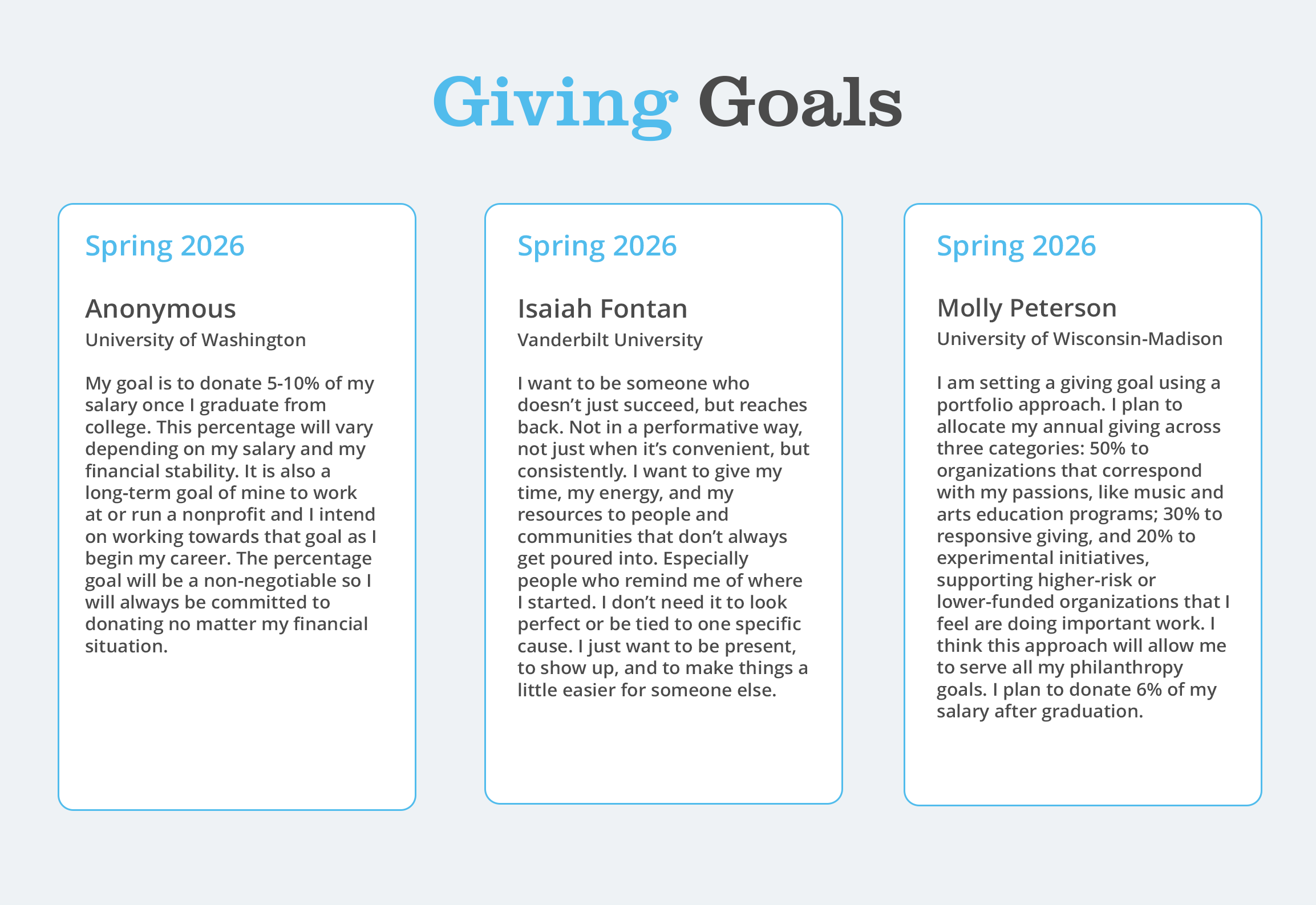
Over 4,200+ course participants have written giving goals in a demonstration of leadership!
Anonymous
- Spring
- 2026
I would like to give around 500-1,000 each year starting from graduation and increase it as time goes on.
Anonymous
- Spring
- 2026
My immediate giving goal is to engage in volunteering and research after graduation. By doing so, it will give me a good idea of how philanthropy works in real life while also giving through my time commitment. I am hoping. that once I graduate from grad school (approximately 10 years), I will be able to donate my money as well.
Anonymous
- Spring
- 2026
My giving goal would be centered around time and expertise, while also doing what I can financially. My goal is to contribute my time, research, and advocacy to closing the gap between neuroscience and the families that need it most. I want to give in ways that resonate closest to my own lived experiences. I am committed to giving in a way that is both on the ground and direct as well as financially.
Anonymous
- Spring
- 2026
Giving to nonprofits matters because it directly funds programs and services that address real needs, whether that’s education, healthcare, food security, or social support. Individual contributions, no matter the size, collectively enable nonprofits to operate, expand their impact, and respond to challenges that might otherwise go unmet. Supporting nonprofits is a practical way to invest in stronger, more equitable communities. So I hope to do that in the future independently and with my partner for years to come.