
I want to orientate my personal giving goals towards my own community back home, focusing on changing the norms of giving inherent in my society. But I also realize that this change has to be recognized and practiced by myself first, before I can start talking to my community. The necessary conversation I want to have with my family and friends back home is inspired by Michael Walzer’s “On Humanitarianism: Is Helping Others Charity, or Duty, or Both?” – where I would like to challenge myself and my community to find or create a space where we can honor sacred traditions but also be more conscious of our actions when we give, that our acts of giving is indicative of our social structure and how we as individuals are interconnected. Essentially, I want to have conversations that highlight how when giving is understood as charity, not as justice or as a humanitarian obligation, there is implications of power relations, which can reinforce certain dominant and subordinate roles in any society. My personal giving goal, is to help cultivate a collective conscience in giving, and it begins with me.

What is a Giving Goal?
Often, the idealism of youth is lost as one achieves success and acquires material possessions later in life. What was originally considered to be “enough” or even “beyond my wildest dreams” can become just another milestone on one’s quest…
Capturing your current vision of how you wish to give of yourself and your resources in the future could help you plan to give more meaningfully. Revisiting this vision in ten or twenty years could provide a reminder of the ideals of your youth that may shape or re-shape your future actions.
If you have already posted your Giving Goal and would like to update your email for future reminders, please contact [email protected]
Step 1
Have a healthy and vigorous dialogue in your class on the general idea of having a personal Giving Goal as a college student.
Step 2
Set a Giving Goal concerning your future giving plans.
Step 3
Share a brief statement of your Giving Goals on The Philanthropy Lab’s portal as a way to inspire others to do the same. You may post anonymously to the public if you wish.
Step 4
Share your permanent email address and phone number with The Philanthropy Lab, for the sole purpose of the reminder mechanism, so we can remind you of your goal in 5 year increments for 20 years into the future.
Alumni Reflections
Search for Giving Goals
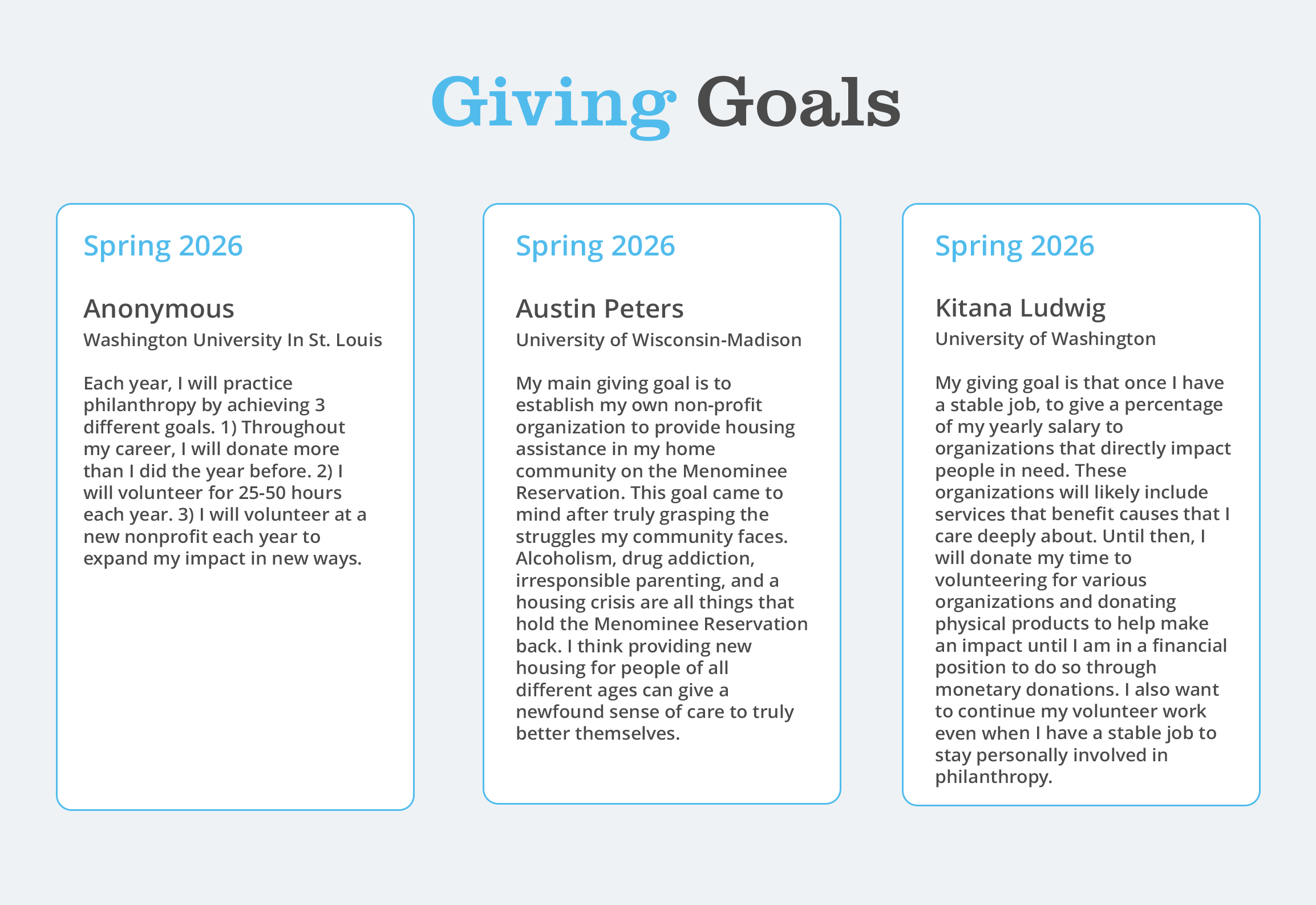
Over 4,200+ course participants have written giving goals in a demonstration of leadership!
Anonymous
- Spring
- 2018
I pledge to hold myself accountable to the impact I have on the world. Primarily this means making concerted efforts to understand my communities, my industry, and communities my life and work impact. Although I sincerely hope that my conception of justice will grow and refine over time, I pledge to never use a lack of surety as an excuse for inaction. I pledge to frequently challenge my ideas of what is “mine” and to ask myself why I am giving what I am currently giving. There is so much I cannot predict about how my life will go, but I think a good benchmark would be to frequently compare my earnings with the average in my area and, if I make more, to ensure that I have a good reason for any of the rest that I do not give away. No matter what I make, I pledge to occasionally ask myself what it would look like to live on the lowest means possible, and then to use that as a benchmark from which I must have good reasons for expenses. Most of all, I hope that my work remains centered around advocacy.
Anonymous
- Spring
- 2018
I pledge to give 5-10% of my income and my time to advocacy causes once I am established in the working world.
Anonymous
- Spring
- 2018
I pledge to give 5% of my salary to well-researched philanthropic causes until my salary is above $115,000, after which I will give more depending on my family situation and whether I am still working in public service. I will also spend 4 days a month volunteering in my community (at local school, hospital, Boys & Girls Club, etc.).
Anonymous
- Spring
- 2018
I pledge to give 10% of my income and my time, when I have a disposable income, specifically to marginalized communities and indigenous causes.