
I pledge to give at least 10% of my income to an organization for which I have done my own due diligence for. As my income increases over the years so will the amount of money I pledge to give. I also pledge to volunteer at least 40 hours per year with an organization.

What is a Giving Goal?
Often, the idealism of youth is lost as one achieves success and acquires material possessions later in life. What was originally considered to be “enough” or even “beyond my wildest dreams” can become just another milestone on one’s quest…
Capturing your current vision of how you wish to give of yourself and your resources in the future could help you plan to give more meaningfully. Revisiting this vision in ten or twenty years could provide a reminder of the ideals of your youth that may shape or re-shape your future actions.
If you have already posted your Giving Goal and would like to update your email for future reminders, please contact [email protected]
Step 1
Have a healthy and vigorous dialogue in your class on the general idea of having a personal Giving Goal as a college student.
Step 2
Set a Giving Goal concerning your future giving plans.
Step 3
Share a brief statement of your Giving Goals on The Philanthropy Lab’s portal as a way to inspire others to do the same. You may post anonymously to the public if you wish.
Step 4
Share your permanent email address and phone number with The Philanthropy Lab, for the sole purpose of the reminder mechanism, so we can remind you of your goal in 5 year increments for 20 years into the future.
Alumni Reflections
Baylor Alum
"What a sweet reminder of this pledge! I've definitely given and volunteered in the last 6yrs. It's been a joy to continue the journey of generosity since graduating from undergrad. I'm back in grad school and I am looking forward to finishing my MSW. There will be new ways I give back to the community!"
Columbia Alum
"Thank you so much for this valuable reminder of my Giving Pledge. I'm proud to say I've dedicated several hours of volunteer time & services to Arts Education non-profits and will continue to live out this pledge"
Harvard Alum
“Thanks for reaching out––I'm actively still volunteering at two non-profits now in NYC (one free food service called "Wellfare" and a neighborhood homeless shelter)”
Wisconsin Alum
"Thank you for your email! The Philanthropy Lab was a life changing experience for me. I ended up joining the board of Malawi Children's Village to run the women empowerment program, which is what the Philanthropy Lab grant was for. In August, I am going to Malawi to see the project in action!"
UT Alum
"I was so happy to see this email pop into my inbox, it feels like a lifetime ago I was in this course. I appreciate all that I learned in this class and have taken its messages with me through these past 5 years. I do plan on maintaining the promise I made in this class"
Baylor Alum
"Thanks for this reminder. I actually still have a handwritten version of that note on the magnet board in my home office."
Search for Giving Goals
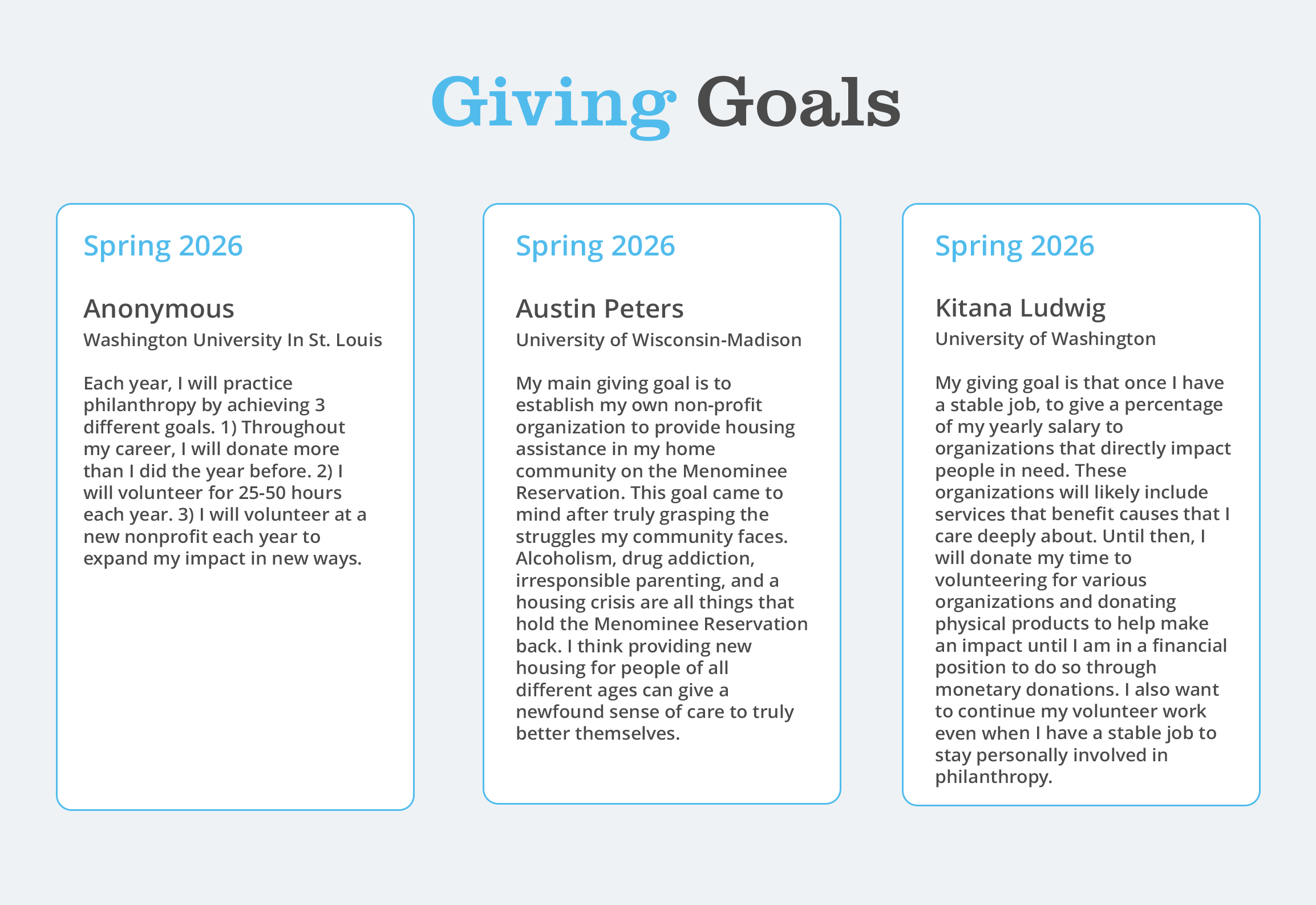
Over 4,200+ course participants have written giving goals in a demonstration of leadership!
Anonymous
- Winter
- 2018
I aim to contribute my time and intellectual efforts towards a philanthropic/charitable endeavor that aims to mitigate inequity at its underlying roots. After completing graduate school, I hope to donate 2% of my annual income to charity for my first 5 years, 5% for my next 10 years, and 10% after that, until I reach a level of long-term economic security that I feel I can dramatically increase my life-long commitment to supporting philanthropic opportunities.
Anonymous
- Winter
- 2018
My goal is to give 5% of my income until I turn 30, then I want to give 15% for the remainder of my life.
Anonymous
- Winter
- 2018
I’d like to commit to giving 5% of my income annually, in perpetuity, after I graduate law school.
Anonymous
- Winter
- 2018
Throughout my lifetime, I pledge to designate a portion of my income towards charitable giving and to designate a portion of my monthly schedule towards public and community service. As I embark on my career, I pledge to sponsor campus clubs and community organizations and scholarships, both at UC Irvine and at Diamond Bar High, to support the endeavors of intelligent, young students who aspire to impact the world through community engagement.
Anonymous
- Winter
- 2018
Public Statement: During my tenure as a student, I pledge to devote 3-5 hours of my time on a weekly basis, to organizations addressing humanitarian issues (homelessness, poverty, environmental deregulation, etc.). Upon completing my education and obtaining a stable career, I strive to provide philanthropic organizations with monetary donations and public support, through collaborating with non-profit leaders to strategize and improve the organization’s mission. Vision: I envision myself remaining politically involved, a helpful tool as I continue to focus on contributing to philanthropic causes. Ultimately, I thrive to run for public office, giving me an opportunity to publicly advocate for philanthropic organizations, garnering them local support. While it would realistically be difficult to win, if victorious, I would ensure philanthropic organizations, were provided with proper funding. Although this would be based on the designated budget I have to work with, I would partner with community members and local leaders to make it clear to governmental bodies that philanthropic organizations are important and deserve external funding (if they can accept it). Nonetheless, if this would not be a feasible solution, I would address legislation that helps the organization’s mission. For instance, in some cities it is illegal to feed homeless peoplle, if this was the case in my jurisdiction I would ensure to pass an ordinance making it legal. All in all, I hope to provide philanthropic organizations with resources beyond monetary contributions and volunteering.