
My giving goal is to donate and give away 10% to anywhere I chose. I also would like to volunteer at an organization or non profit least once every two weeks. If my income gets to be over $80,000 while I have no kids I want to increase my percentage donated.

What is a Giving Goal?
Often, the idealism of youth is lost as one achieves success and acquires material possessions later in life. What was originally considered to be “enough” or even “beyond my wildest dreams” can become just another milestone on one’s quest…
Capturing your current vision of how you wish to give of yourself and your resources in the future could help you plan to give more meaningfully. Revisiting this vision in ten or twenty years could provide a reminder of the ideals of your youth that may shape or re-shape your future actions.
If you have already posted your Giving Goal and would like to update your email for future reminders, please contact [email protected]
Step 1
Have a healthy and vigorous dialogue in your class on the general idea of having a personal Giving Goal as a college student.
Step 2
Set a Giving Goal concerning your future giving plans.
Step 3
Share a brief statement of your Giving Goals on The Philanthropy Lab’s portal as a way to inspire others to do the same. You may post anonymously to the public if you wish.
Step 4
Share your permanent email address and phone number with The Philanthropy Lab, for the sole purpose of the reminder mechanism, so we can remind you of your goal in 5 year increments for 20 years into the future.
Alumni Reflections
Baylor Alum
"What a sweet reminder of this pledge! I've definitely given and volunteered in the last 6yrs. It's been a joy to continue the journey of generosity since graduating from undergrad. I'm back in grad school and I am looking forward to finishing my MSW. There will be new ways I give back to the community!"
Columbia Alum
"Thank you so much for this valuable reminder of my Giving Pledge. I'm proud to say I've dedicated several hours of volunteer time & services to Arts Education non-profits and will continue to live out this pledge"
Harvard Alum
“Thanks for reaching out––I'm actively still volunteering at two non-profits now in NYC (one free food service called "Wellfare" and a neighborhood homeless shelter)”
Wisconsin Alum
"Thank you for your email! The Philanthropy Lab was a life changing experience for me. I ended up joining the board of Malawi Children's Village to run the women empowerment program, which is what the Philanthropy Lab grant was for. In August, I am going to Malawi to see the project in action!"
UT Alum
"I was so happy to see this email pop into my inbox, it feels like a lifetime ago I was in this course. I appreciate all that I learned in this class and have taken its messages with me through these past 5 years. I do plan on maintaining the promise I made in this class"
Baylor Alum
"Thanks for this reminder. I actually still have a handwritten version of that note on the magnet board in my home office."
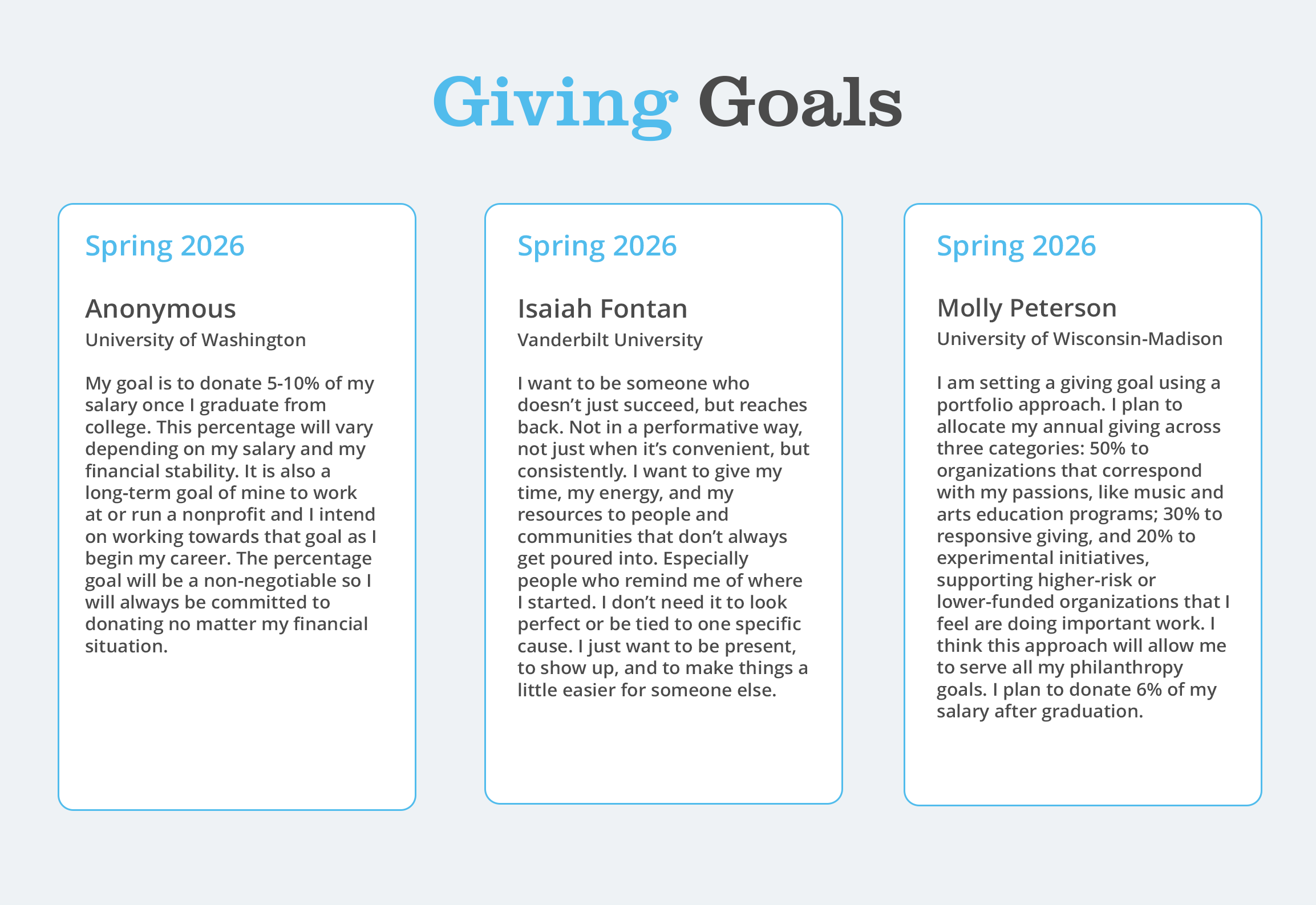
Search for Giving Goals
Over 4,200+ course participants have written giving goals in a demonstration of leadership!
Ivan Huang
- Spring
- 2024
The purpose of giving to others carries profound significance. Having grown up in a family that started from nothing and gradually built its way up, I’ve developed a deep understanding of the struggles and challenges people face in life. Any little bit of giving counts when you are in a tough situation. My family, especially my mother, has always been recognized as a very generous person, even when she had very little at times. Her experience running a restaurant, and my observations of her, taught me that personal connections are more important than the cost of a meal. She would never allow friends and family to pay for meals and always ensured everyone was happy. I take this philosophy to heart and understand the importance of giving. I have come to believe that to give well involves not only the act itself but also considering where, to whom, and how the giving is done. My past personal experiences with giving are limited. As a student, I do not have much money to my name and have always been supported by my parents. That being said, the most impactful act of giving in which I have participated was during my high school years. From eighth through twelfth grade, I was fortunate enough to attend an all-boys private Catholic military preparatory school. This institution was grounded in Lasallian education and military leadership. At the school, we were taught to be very structured, disciplined, and respectful. We had to wear different military uniforms every day, attend weekly drills, and participate in many ceremonies. When I first arrived at the school, I learned about a group of seniors from the past who had come up with an idea. They collaborated with the school and military administration to coordinate monthly dress-down days for charity. Students and administration worked together to select a charity or group in need for that month and collect five dollars from students who wished to be out of uniform for the day. In my early days of high school, I did not grasp the meaning or purpose, as I was still young and naive. I would just give my five dollars and call it a day. It was not until my senior year, when I caught a glimpse of what we were doing, that my perspective on donating those five dollars every month changed. Looking back, I realized the impact we were making. Every month, we collectively raised up to three thousand dollars, whether it was money for the local food bank or funds to build a well in South Sudan. Wherever our money went, it served a great purpose and helped significantly. Personally, I feel as if direct forms of giving are the best option. I want to be able to know my impact and see it. The local food bank is where I donate money and my time as a volunteer, and I get to actually see what I am involved in. To me, that is important, and it also reassures me that my money is being put to good use. That personal connection also plays a big role in giving. As we discussed in class, whether I would save someone in front of me or five thousand miles away with the same action puts me in a difficult position. Everyone in this world is important and serves a purpose, so they should be equal in my eyes; however, human nature makes me see things differently. This past weekend, with the ten dollars received in class, I got together with a couple of my friends and went grocery shopping for the local Brookline Food Pantry, getting things they needed to pack and send out to families in need. It is efforts like these I feel have the most impact in our community. But, returning to that same argument, there are people outside of America for whom I truly feel sorry and who are in the same situation with the same needs, and I could help them in the same way; however, close to home is what I chose. For it to have the same meaning for me though, I would need to do more research and get the necessary items and resources to the correct organizations. This is the difficult part of giving, and in my opinion, is the reason people tend to only support locally or give to organizations they know well. I believe that in the future, I will continue my philosophy of giving in a way that I can see and follow. However, at the same time, I feel that I will learn a lot from this class and be able to use these new skills to give more efficiently in the future. I will continue to strive to be a better person and help when I can, especially with my time and physical effort. There are many people in this world who need help, and it is those of us who are fortunate enough who can help them the most.
Ismail Sufi
- Spring
- 2024
My giving goals for the future, very basically follow the idea laid out by Peter Singer in his book. I will try to earn enough money such that I will be able to give away larger portions of it. With this I plan to change the actual system that our world is in. Maybe it is unwise to be saying this on a website where anyone can see it. The only way, I believe to cause impactful change is to hit capitalists where it hurts. Many of the problems in the world today are caused by aggressive capitalist methods. If I can become incredibly rich, I am able to directly negate the effects of some other ultra rich people who may only exacerbate the problem.
Ike Blackmore
- Spring
- 2024
Philanthropy Lab opened my eyes to the benefits of developing a systematic giving process. The organization also inspired me to feel like can start giving early. After taking the Philanthropy Lab Class, my giving goal is now to donate 5% of my pretax earnings. I want to support underprivileged youth through mentorship and education. By doing so, I hope to make an impact by helping disadvantaged kids break generational cycles of poverty.
Hollis Brooke Belger
- Spring
- 2024
I’ve been giving philanthropically for over half of my life, and I don’t intend to stop. I do intend to continue my fundraising efforts and developing a professional relationship with selected nonprofits. My goal is to work at the intersectionality of being a donor as well as a direct consultant and employer for nonprofit organizations. While I hope to donate to certain charities with much ethical reflection, I would hope to benefit these organizations on a greater scale either through venture capital, being an employee, or consulting services. I’m equally as passionate about pediatric cancer, accountability, anti-semitism, and other issue areas as I was before engaging in the course, and I intend to think innovatively and carefully about which organizations I choose to allocate my funds. I will work to select organizations based off of research, guidance, and demonstration of impact both quantitatively and qualitatively. I hope to evaluate other societal and environmental circumstances that may influence my philanthropic decisions and be open minded to change and flexibility.
Harsh Dalmia
- Spring
- 2024
My goal would be to always contribute a percentage of my salary towards causes that I support regardless of what I earn. Any and all contribution matters and works towards making a difference. While I am not completely sure of how how much to give I would like to contribute about 2-3% of my pay