
I would like to give away at least 20% of my disposable income when I have a steady salary. I hope to be thoughtful not just about how I give my resources but also how I use the resources I have. Am I being wasteful? Are there better uses of my time? There are many considerations to have.

What is a Giving Goal?
Often, the idealism of youth is lost as one achieves success and acquires material possessions later in life. What was originally considered to be “enough” or even “beyond my wildest dreams” can become just another milestone on one’s quest…
Capturing your current vision of how you wish to give of yourself and your resources in the future could help you plan to give more meaningfully. Revisiting this vision in ten or twenty years could provide a reminder of the ideals of your youth that may shape or re-shape your future actions.
If you have already posted your Giving Goal and would like to update your email for future reminders, please contact [email protected]
Step 1
Have a healthy and vigorous dialogue in your class on the general idea of having a personal Giving Goal as a college student.
Step 2
Set a Giving Goal concerning your future giving plans.
Step 3
Share a brief statement of your Giving Goals on The Philanthropy Lab’s portal as a way to inspire others to do the same. You may post anonymously to the public if you wish.
Step 4
Share your permanent email address and phone number with The Philanthropy Lab, for the sole purpose of the reminder mechanism, so we can remind you of your goal in 5 year increments for 20 years into the future.
Alumni Reflections
Baylor Alum
"What a sweet reminder of this pledge! I've definitely given and volunteered in the last 6yrs. It's been a joy to continue the journey of generosity since graduating from undergrad. I'm back in grad school and I am looking forward to finishing my MSW. There will be new ways I give back to the community!"
Columbia Alum
"Thank you so much for this valuable reminder of my Giving Pledge. I'm proud to say I've dedicated several hours of volunteer time & services to Arts Education non-profits and will continue to live out this pledge"
Harvard Alum
“Thanks for reaching out––I'm actively still volunteering at two non-profits now in NYC (one free food service called "Wellfare" and a neighborhood homeless shelter)”
Wisconsin Alum
"Thank you for your email! The Philanthropy Lab was a life changing experience for me. I ended up joining the board of Malawi Children's Village to run the women empowerment program, which is what the Philanthropy Lab grant was for. In August, I am going to Malawi to see the project in action!"
UT Alum
"I was so happy to see this email pop into my inbox, it feels like a lifetime ago I was in this course. I appreciate all that I learned in this class and have taken its messages with me through these past 5 years. I do plan on maintaining the promise I made in this class"
Baylor Alum
"Thanks for this reminder. I actually still have a handwritten version of that note on the magnet board in my home office."
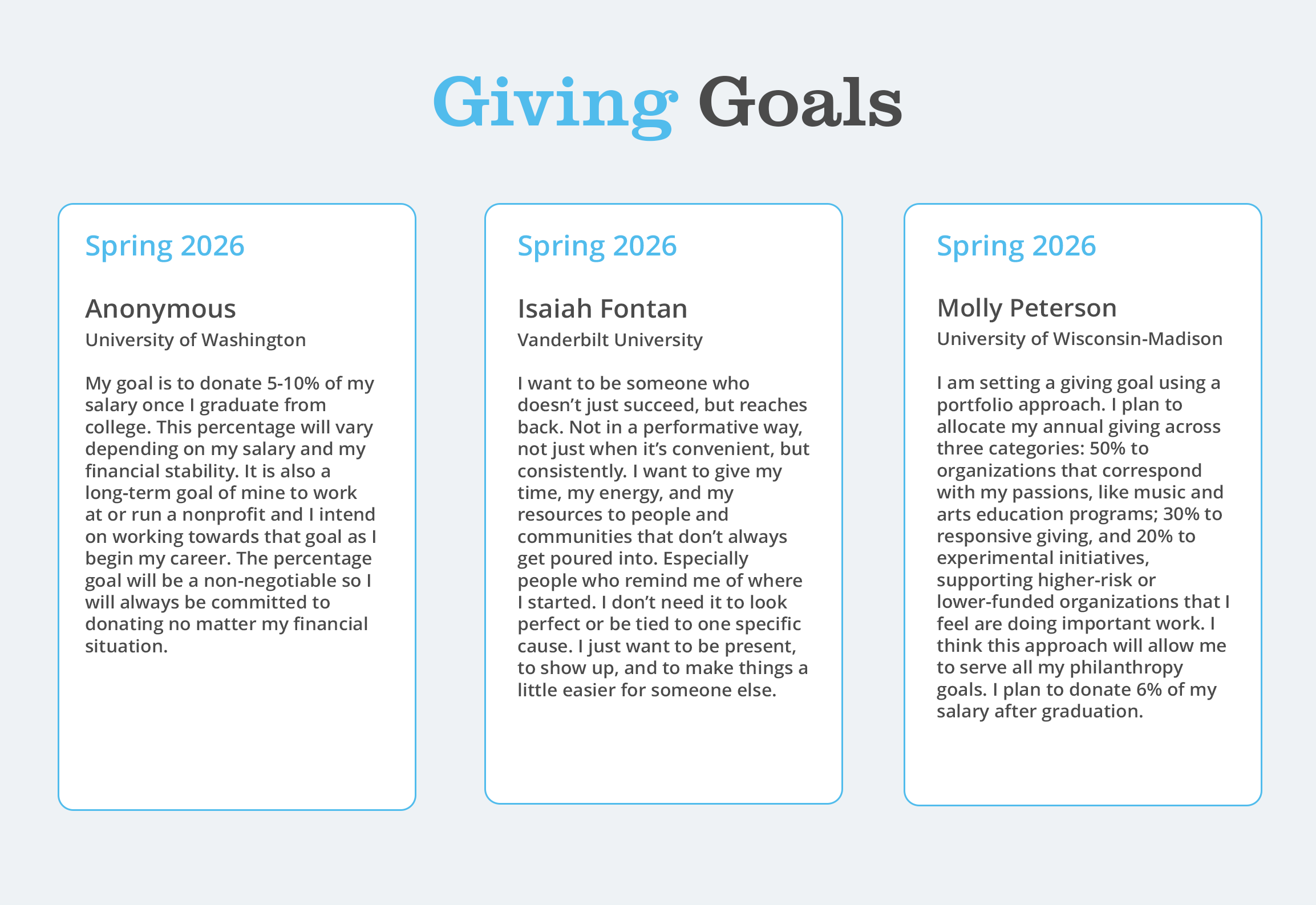
Search for Giving Goals
Over 4,200+ course participants have written giving goals in a demonstration of leadership!
John Wang
- Spring
- 2024
Keep retaining the interest to research where I’d like t o donate
John Kim
- Spring
- 2024
My Giving Goal and personal vision for philanthropy is to solve issues closest to the core problem of human health. What I mean by that is, I will be more interested in giving to organizations that target either healthcare or malnutrition. When I look around me, I see young, healthy people who don’t seem to have any significant problems in life; what I don’t see first-hand is the four-year-olds in Madagascar who have bloated stomachs (due to malnutrition) and are struggling with malaria. While many would focus on other (e.g. renewable energy, diversity, equity & inclusion (DEI), or artificial intelligence), I want to focus on issues that are usually masked by other ongoing, domestic issues. (1026 words)
John Culley
- Spring
- 2024
In the heart of every act of kindness lies a profound story of empathy, connection, and the transformative power of giving. In my family, giving and volunteering always had a place, but it was often rooted in religion. My upbringing, deeply rooted in the Roman Catholic tradition, introduced me to the concepts of giving and volunteering as extensions of our faith. This foundation of philanthropy, intertwined with religious practice, made early experiences of charity both meaningful and personal. We were not just donating and volunteering; we were extending our hands to neighbors and fellow church members, fostering a community of care and support. My journey into the broader landscape of charitable giving began to unfold in middle school with my decision to join “Serving Other Souls,” an initiative coordinated by my algebra teacher. The organization championed a principle that resonated deeply within me: our ability to give extends well beyond monetary contributions. This marked the beginning of a transformative journey that would span my middle and high school years, exploring the myriad ways one can contribute to the betterment of others. A pivotal moment in this journey was my first engagement with the Ronald McDonald House in Pittsburgh, where our group prepared dinner for families grappling with the hospitalization of their children. This experience was not only invigorating but also eye-opening. Sharing a meal and conversations with these families, I was struck by their resilience and optimism amidst unimaginable challenges. This interaction highlighted the significant impact of seemingly small acts of kindness and instilled in me a profound sense of empathy and a commitment to make a difference. Witnessing the morale boost that an evening of companionship and a home-cooked meal could provide was a revelation, showcasing the importance of seemingly small contributions. Throughout the time I spent with “Serving Other Souls,” I embraced and continued to learn the importance of the multifaceted nature of giving and cultivated a profound empathy for individuals whose circumstances seemed worlds apart from my own. It became clear to me that the most fulfilling opportunities were those that allowed me to interact with those in need, fostering a direct connection and immediate impact. Volunteering at the food bank stands out as a particularly rewarding experience with “Serving Other Souls”, offering not just assistance but also meaningful conversations and connections, revealing the rich experiences and stories everyone has to share. While guiding those in need of assistance through the aisles of the food pantry, there was so much time to garner a connection and get to know them on a deeper level. This personal connection is what drove me to continue to give my time on weekends as I would get to see a lot of familiar faces at the food bank as well. These interactions deepened my understanding and desire to contribute, underscoring that need knows no bounds. From supporting families navigating illness to ensuring no one faces hunger during the holidays, the essence of each cause remained the same — to offer help. The diversity of individuals I’ve assisted has profoundly shaped my perspective, teaching me that true giving transcends the amount donated and hinges on understanding and addressing the unique needs of each individual. My experiences have reshaped my view of generosity, showing me that it encompasses not just monetary donations but also time, effort, and engagement. The time I spent with “Serving Other Souls” has fostered a philosophy of giving which has stuck with me that is both flexible and inclusive, recognizing that while our abilities to contribute may vary, the act of giving itself is a universal virtue. Reflecting on my evolved philosophy of giving, I’ve learned that the true measure of giving is not determined by the size of the contribution but by the sincerity of the effort and its impact. This journey has reinforced my belief that at the heart of every act of kindness lies a powerful story of change and hope, emphasizing that the most profound gifts we can offer are those of empathy and connection. It’s a testament to the fact that every individual has the potential to make a significant difference in the lives of others, regardless of the scale of their contributions. My journey has taught me that the essence of true giving lies in the joy and fulfillment that comes from connecting with and helping others, a lesson that will continue to guide me as I seek to contribute to the world around me.
Jiayue Lu
- Spring
- 2024
Charitable giving, a tradition as old as human society, has grown into a complex activity that goes beyond simple exchanges. It has become a big part of how communities operate. My personal philosophy in charity is deeply influenced by my family and school experiences. Growing up in a middle-class family that didn’t have the need to receive, my understanding and values around giving were shaped by what I was taught to contribute. Going to a Catholic high school has embedded me with the importance of volunteering and donating, not just as acts of charity but as acts to express sense of community and empathy. These experiences were crucial in shaping my understanding of charity. The essence of giving, in my point of view, is deeply rooted in the cycle of positive karma. The belief that good deeds return to the giver in many ways is not just in forms of money or material but spiritually satisfaction. This belief motivates me to extend help and support to others, not with the expectation of direct returns but with the faith that contributing to the greater good elevates us all. It’s a belief that places higher value on the spiritual and emotional growth of both the giver and the receiver than on the physical gifts exchanged. This reflects my view that true generosity enriches both parties involved and the cycle of positive karma. Thinking of the causes to support, I am guided by two simple yet profound questions: who is in need, and how can I help within my ability? This approach ensures that my efforts are not just heartfelt but practical, targeting issues which I can make a real difference with what I am able to offer. Whether it’s donating money to those in financial crisis or volunteering in food drives, the goal is to address immediate needs while also considering longer-term impacts. My giving is not indiscriminate but thoughtful, aiming to create ripples of change that extend beyond the immediate horizon. The question of how much one should give is important yet complex, intertwined with personal circumstances, abilities, and the needs of those around us. My philosophy leans towards giving in a way that does not compromise one’s quality of life. It’s a balance that respects the giver’s circumstances while still pushing the boundaries of generosity. This balance ensures that the act of giving remains sustainable and create a culture of generosity that can endure and grow over time. On the topic of the obligation to give, I believe that while the amout to give may vary, the responsibility to contribute to the well-being of our community is universal. Monetary contributions, while significant, are not the only form of giving. Sharing resources, time, or even listening to others, simple stuff can be equally valuable. The measure of giving, therefore, should not be quantified only in monetary terms but in the sincerity and impact of the contribution. This perspective allows for a more inclusive understanding of charity, where everyone, regardless of their financial situation, has something valuable to offer. My giving is not driven by religious conviction in the traditional sense. Though my family practices Buddhism, my approach to giving is more about empathy and a deep belief in the connection of all beings. This spiritual backdrop encourages me to see giving not as an obligation but as a natural expression, recognizing that the well-being of others directly influences my own. Charitable giving plays a crucial role in society, especially in the United States. America is a country known for its wealth, but it also faces significant inequality. Charity becomes an essential way to redistribute resources, a way to help ease the hardships of those in need and bringing people closer together. It shows how a society can become stronger when its members care for one another and work together. The idea behind it all is simple yet powerful that by helping others, we all obtain a better society, life. This belief in compassion and mutual aid is what makes charitable giving so important. At the end of the day, my personal giving philosophy is a combination of my experiences and personal beliefs shaped by my experiences. It’s a philosophy that sees giving as an essential component of human connection, a way to bridge divides and build a more compassionate, empathetic world. As I continue to explore the world and learn more about humans, this philosophy will continue guide my actions and remind me of the power of generosity to transform both the giver and the receiver.
Jhilmil Hatty
- Spring
- 2024
I want to find organizations that pertain to children’s education, volunteer one weekend a quarter. In five years I want to allocate 5% of my salary to give away