
I wish I had a job while doing philanthropy on the side. I am aware of everything that happens around us and we can be the change to improve things. In the future I see myself donating or volunteering at non-profit organizations that need it.

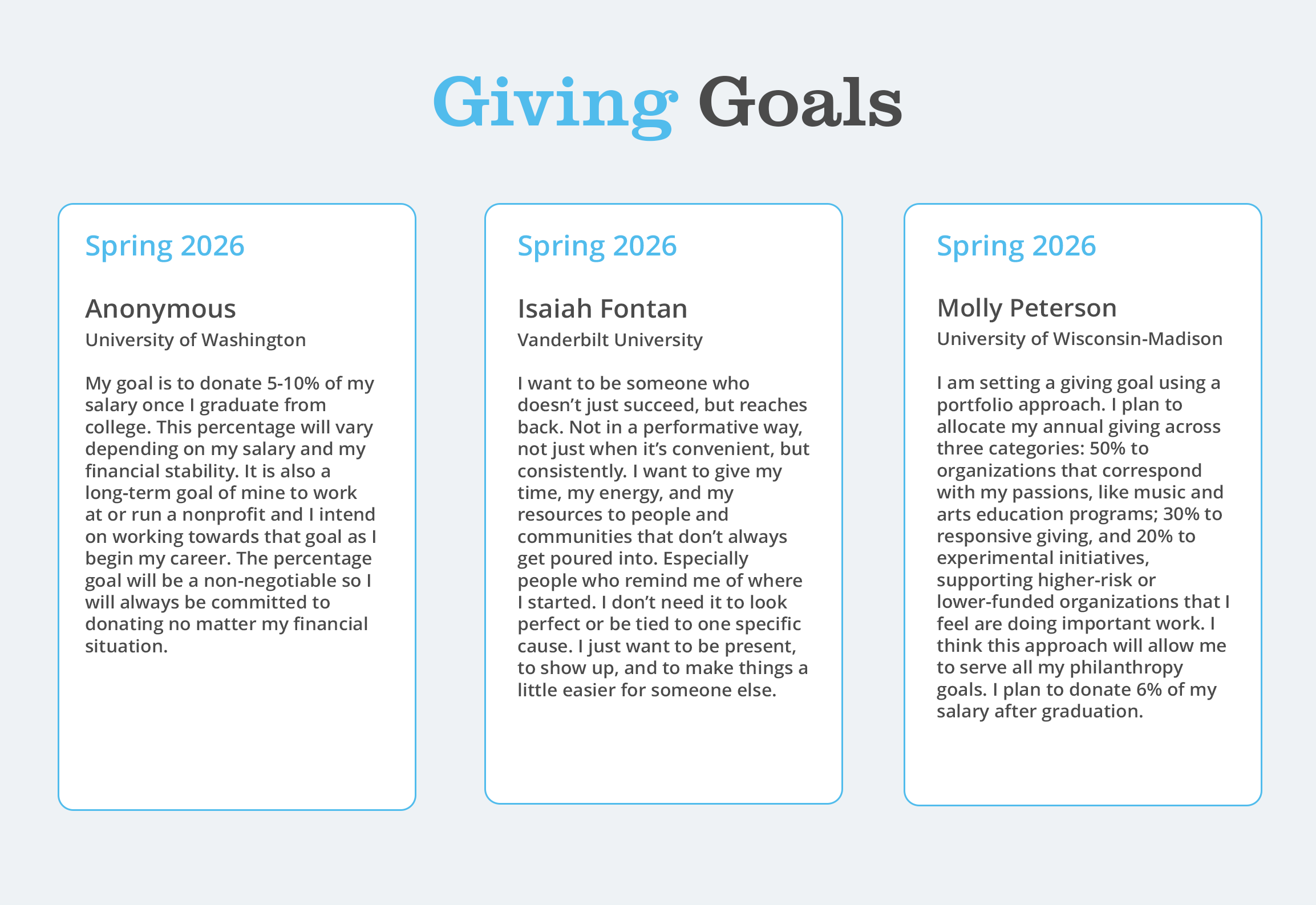
What is a Giving Goal?
Often, the idealism of youth is lost as one achieves success and acquires material possessions later in life. What was originally considered to be “enough” or even “beyond my wildest dreams” can become just another milestone on one’s quest…
Capturing your current vision of how you wish to give of yourself and your resources in the future could help you plan to give more meaningfully. Revisiting this vision in ten or twenty years could provide a reminder of the ideals of your youth that may shape or re-shape your future actions.
If you have already posted your Giving Goal and would like to update your email for future reminders, please contact [email protected]
Step 1
Have a healthy and vigorous dialogue in your class on the general idea of having a personal Giving Goal as a college student.
Step 2
Set a Giving Goal concerning your future giving plans.
Step 3
Share a brief statement of your Giving Goals on The Philanthropy Lab’s portal as a way to inspire others to do the same. You may post anonymously to the public if you wish.
Step 4
Share your permanent email address and phone number with The Philanthropy Lab, for the sole purpose of the reminder mechanism, so we can remind you of your goal in 5 year increments for 20 years into the future.
Alumni Reflections
Baylor Alum
"What a sweet reminder of this pledge! I've definitely given and volunteered in the last 6yrs. It's been a joy to continue the journey of generosity since graduating from undergrad. I'm back in grad school and I am looking forward to finishing my MSW. There will be new ways I give back to the community!"
Columbia Alum
"Thank you so much for this valuable reminder of my Giving Pledge. I'm proud to say I've dedicated several hours of volunteer time & services to Arts Education non-profits and will continue to live out this pledge"
Harvard Alum
“Thanks for reaching out––I'm actively still volunteering at two non-profits now in NYC (one free food service called "Wellfare" and a neighborhood homeless shelter)”
Wisconsin Alum
"Thank you for your email! The Philanthropy Lab was a life changing experience for me. I ended up joining the board of Malawi Children's Village to run the women empowerment program, which is what the Philanthropy Lab grant was for. In August, I am going to Malawi to see the project in action!"
UT Alum
"I was so happy to see this email pop into my inbox, it feels like a lifetime ago I was in this course. I appreciate all that I learned in this class and have taken its messages with me through these past 5 years. I do plan on maintaining the promise I made in this class"
Baylor Alum
"Thanks for this reminder. I actually still have a handwritten version of that note on the magnet board in my home office."
Search for Giving Goals
Over 4,200+ course participants have written giving goals in a demonstration of leadership!
Lauren Rogge
- Spring
- 2024
I want to give substantially to a couple organizations in my community with missions close to me where I can donate and volunteer.
Lauren Fox
- Spring
- 2024
Greivability is the motivator of giving. This concept, as discussed in class last week, has really stuck with me as I think about my personal feelings about charity. From a young age, I remember each birthday receiving a card from my grandmother that was not filled with the money I was hoping for but rather a donation in my name to her own charity. Before being of age to understand what this meant, I was a doner to NOHR– the National Organization for Hearing Research Foundation. My grandmother grieved the loss of her own hearing and used that personal experience to help push for research in hearing loss prevention. Looking back at my ignorance of not understanding the uniqueness of this gift, I now acknowledge that this was my first instance of giving, whether I liked it or not. I grew up in the middle—the middle child, in the middle of nowhere Colorado, in the middle class. I have always been very aware of my privilege and understanding that I didn’t choose to grow up in the States with a loving family, the same way people don’t choose to grow up in very different circumstances. This being said I can’t remember my family speaking much about donating when I was growing up. While we had expendable income, most of my “giving to charities” came in the form of volunteering for the National Honors Society or community events. I remember helping at annual food drives or at college fairs in Middle and High School. One organization that was very prevalent throughout my childhood was Protect Our Winters (POW). I cared about this nonprofit because I grieved the changes that I was seeing in my small mountain town as less snow seemed to fall each year, and in turn, the economy struggled. POW would come into my town every year and do events for which high school students, including myself, would volunteer. I think that this attests to my philosophy of giving. I often have a hard time trusting where money would be going with large institutions. When you donate time, instead of money, you have full power over the influence of your giving. This philosophy may be because my family has never had vasts of extra money going to charities, or didn’t talk about it, but I have heard stories of corruption within nonprofits. While these are most likely the minority of nonprofits, I still worry that my money will get lost in the middle or not be used for its intention with larger organizations. If you hand food to someone who is hungry, you know they are getting food. If you donate money to an organization that feeds the hungry, you don’t know if that money is paying a salary or feeding someone in need. This isn’t to say that all charities are bad, and I am excited to learn about good organizations this semester, but I bring a level of skepticism to charities. I believe that charitable causes involving humans are most important. If I were given money and were told to choose to donate it to POW or a humanitarian organization, I would pick the latter despite my personal connection to POW. As a Human Right Studies minor at BU, I have a draw to humanitarian stories and studying the human condition throughout history. This being said, I do strongly believe that crises like global warming have dire effects on humans and are one of the world’s greatest threats at the moment, so supporting a cause in that realm will, in turn, help humans. I think capitalism is really interesting to think about in terms of charity. As we discussed in class with the Singer reading, if everyone with disposable income gave away that money, would there be any suffering? This is impossible in a capitalist society where there is a large disparity between the rich and the poor, but it fascinates me to think about it in terms of human greed. This brings me to the question of who is entitled to give. I have heard stories of people who have so little themselves, yet they still give to those even less fortunate, and vice versa. I like to think that those who can give away money will, but I also think that depending on where you live in the world, you believe that different things are necessities in your life and, therefore, don’t give away that extra money that would stop you for traveling or buying new clothes. I am not an exception to this rule and am aware that the things that I treat as normal to have in my daily life, may be viewed as luxurious in other places and seen as money I should rather give away. I grew up with the angel and devil on my shoulders in terms of religion and giving. My father was born and raised on the mainline of Philidelphia to a Jewish family, and my mother grew up in the Middle East practicing no religion but experienced the clashes of opposing forces leave her local grocery store and school in rubble. While my mother converted to Judaism when she and my father married, she is not shy to critic and question all things religion. This has placed me in a unique perspective to similarly question the motivations of giving for religion. Furthermore, I have never given money to religious organizations, and I am aware that I carry a stigma when it comes to “donating to the church (synagogue, etc).” I think that my philosophies around giving are very easily swayed on a case-by-case basis, and I am really looking forward to getting more concrete theories of charity in this course.
Lauren Aswad
- Spring
- 2024
I will give my time, talents, and treasures to a purpose greater than myself. I pledge to be mindful of the needs around me and keep my open for opportunities to give. I pledge to give in abundance with a joy filled heart. I will surrender my life to God daily and ask Him how I can serve. I will strive to live a life of generosity, humility, and intentionality. I pledge to give according to my values and use my gifts to make a positive impact in the world.
Laure Hartmanshenn
- Spring
- 2024
My goal is to always have a charity that I am actively volunteering for every year. I do not need to stay with this charity my whole life, in fact, I encourage myself to go support multiple organizations in my lifetime – animal welfare, human education, environmental support. Once I have built equity post McCombs, I plan to donate what I can every year to an organization that I am passionate about.
Laredo Regular
- Spring
- 2024
My giving goal consists of monetary donations, volunteering and providing pro bono services. After attending this class and getting the opportunity to speak with various organizations, I see a high need in monetary contributions and pro bono services.