
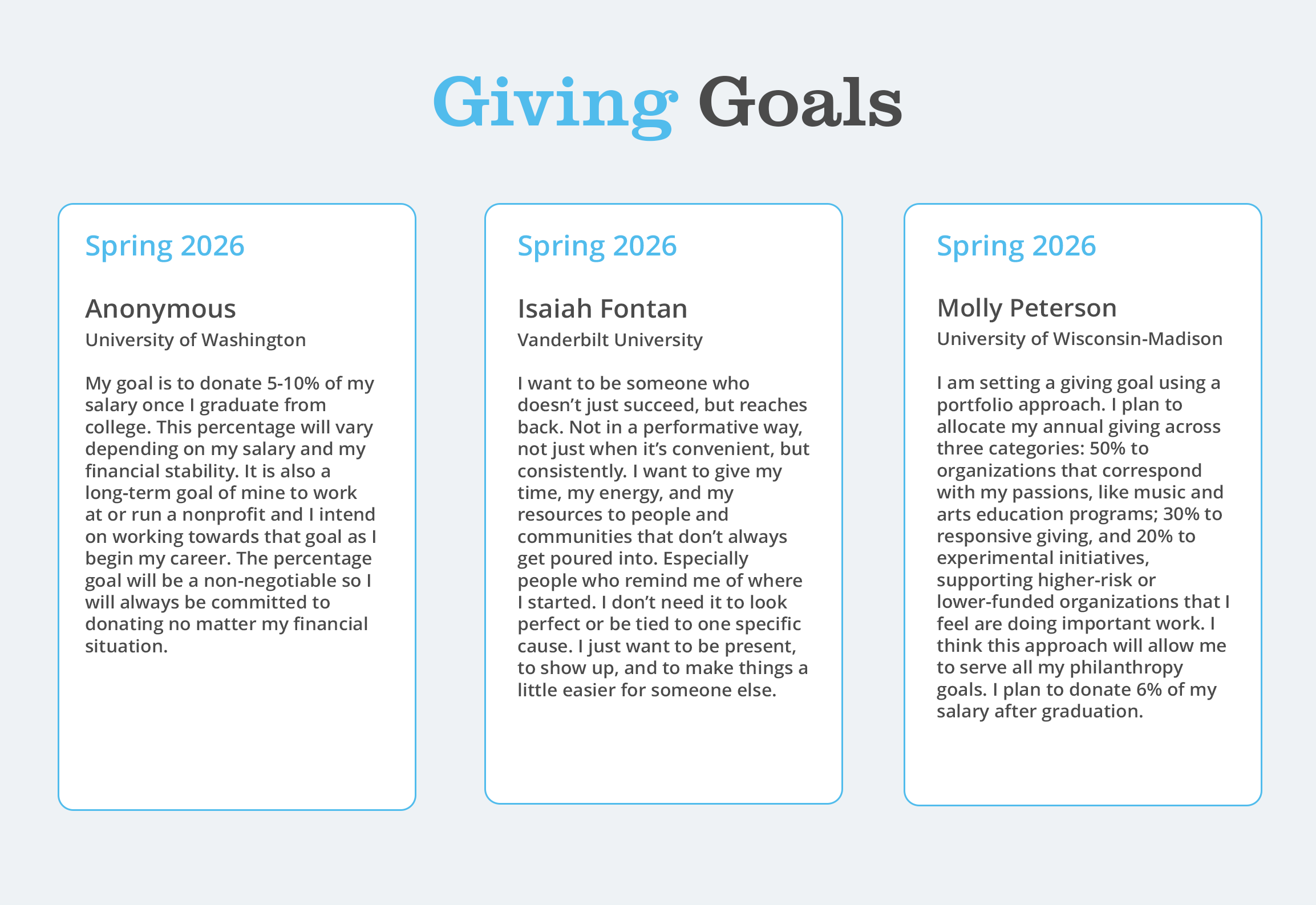
My giving goal is to yearly donate $100 to organizations that support our education system. Many of our most heated debates have to do with equal opportunity and what is considered to be fair and equal. But when the future of our society is soon to be in the hands of our younger generation, we must ensure that we are doing everything possible to teach and motivate them correctly in a system that is operated fairly and in their best interest. The right to an education is a freedom every child should have. But sadly, in today’s society, initiatives and laws make it nearly impossible for all children from all different walks of life to have an equal education. I would also like to give 8% of my income to help those around me and to organizations whose mission is centered around cancer, systematic injustices, prison reform, and global issues. I want to be consistent in my giving by giving intentionally. I also plan to give my time to help and be at the forefront of the issues I care so deeply about right in my community by volunteering at a minimum of once a month. This summer, I want to get back into the habit of giving, whether it be time, money, or at some point being a board member. The act of giving to something bigger than myself and making a positive impact in my local and global community is important to me as I aim to live my life in service to others. I plan to evaluate this goal as my interests, passions, and income change over the next few years.

What is a Giving Goal?
Often, the idealism of youth is lost as one achieves success and acquires material possessions later in life. What was originally considered to be “enough” or even “beyond my wildest dreams” can become just another milestone on one’s quest…
Capturing your current vision of how you wish to give of yourself and your resources in the future could help you plan to give more meaningfully. Revisiting this vision in ten or twenty years could provide a reminder of the ideals of your youth that may shape or re-shape your future actions.
If you have already posted your Giving Goal and would like to update your email for future reminders, please contact [email protected]
Step 1
Have a healthy and vigorous dialogue in your class on the general idea of having a personal Giving Goal as a college student.
Step 2
Set a Giving Goal concerning your future giving plans.
Step 3
Share a brief statement of your Giving Goals on The Philanthropy Lab’s portal as a way to inspire others to do the same. You may post anonymously to the public if you wish.
Step 4
Share your permanent email address and phone number with The Philanthropy Lab, for the sole purpose of the reminder mechanism, so we can remind you of your goal in 5 year increments for 20 years into the future.
Alumni Reflections
Search for Giving Goals
Over 4,200+ course participants have written giving goals in a demonstration of leadership!
Sarah Kim
- Spring
- 2024
I pledge to dedicate both my time and financial resources to supporting the causes I am passionate about. I will donate 5% of my income to an organization that improves education equity. Additionally, I will donate another 3% of my income to a new organization each year, based on extensive research. I will also volunteer at both community service events that fulfill immediate needs, such as food pantries, as well as advocacy events where I can uplift the communities I care about.
Sarah Idris
- Spring
- 2024
My inclination to philanthropy stems from my experiences as a child in Ethiopia, faith, and education. My experience with charity, philanthropy, and nonprofits have contributed to my pragmatic view towards both giving and volunteering. This essay identifies the cause I subscribe to, the philanthropist shaping my perspective, and my goals within the philanthropic landscape balancing the emotional drive with the practical strategies. Current Philanthropic Engagement At the moment, my (scarce) monetary philanthropic focus revolves around relief and development, while my volunteer work is dedicated to supporting refugees and promoting empowerment through business. In giving towards relief, money is used to respond to relevant present crises. Such examples are water tanks, water well, natural disaster relief, and humanitarian tragedies such as those being faced by Palestinans. In such cases, I can almost believe “every dollar makes a difference” and definitely that time-sensitive support can make a big difference in the processes of recovery. However, I also do believe that volunteers are vital for the success of the effort. For example, sometimes in development, there can be a case made that the central figures in philanthropic endevour should be ones that are or were affected by the thing being addressedm as they bring a unique perspective and firsthand understanding of the challenges and needs involved. This personal connection can often lead to more impactful and empathetic solutions. Dissimilarly, in relief efforts, the people being affected are mostly likely to be victims and may not even be able to volunteer or help those around them, airplane mask analogy. Though there are exceptions, such as heroic people who are able, helping in the very situations they are victim to, such cases include Palestine today and Luisianans in Hurricane Katrina. Yet these are the very situations that require volunteers and multifaceted intervention from the world. By this I mean helping bodies, organizational managers, govermental aid, relief packages, food, water, shelter, and then anything beyond to help the victims get resettled. When these incidents occur and there is a plethora of money, but a lack of volunteers, we can safely assume that the effort is going to perform suboptimaly and have a lot of inefficiencies. In relief efforts, time-sensitive support can make a big difference in the processes of recovery. Inspiration for Philanthropy I believe I am disillusioned by the idea of an idol or hero to a great extent. I feel like a lot of people that are portrayed as heroes are either not depicted accurately, and that if in fact, they were truly portrayed, they would be considered outside of the norm. Inversely, I feel like once people get older and they learn more about society’s idols, they realize they fall short on moral grounds. That being said, listening to Dr. William’s lecture in class was very inspiring in terms of inspiration for a philanthropist, but it was somewhat sobering to hear a lot of the facts on the racial work gaps. The Black Wealth Initiative exemplifies a commitment to dealing with the deep-seated issues of racism and colonialism. Those things being considered, their impact being rightly weighted, and that being addressed through the facet of wealth makes it inspiring for me. I think one reason why so many people in and outside of our class call philanthropy “complicated” is due to the “white savior” nature as well as its (sometimes calculated) inefficiencies. Dr. William’s model of philanthropy is characterized by deep data analysis, a huge trust in the capability and potential inherent in her employees and the people and communities to which she gives, and a critical evaluation of systemic barriers. Placing a primary emphasis on building relationships “at the pace of trust” and understanding community needs, not only represents values of good philanthropy but should be strongly considered as the foundation of good philantropists, especially if they are centered on community. The reason I strongly believe in “grassroots” philanthropic efforts is two fold. One is a proverb in my culture and religion that emphasizes taking care of your neighbor before caring for the whole world. This just makes sense to me on so many levels. I went to public schools in Texas where I was very aware of the fact that some people totally depend on the food provided by school. Additionally, I believe in the concept of neighboors. Prophet Muhammed (peace be upon him) is quoted to have said, “He does not have faith in me who spends the night satiated while he knows that a neighbor to his side is hungry.” There lies such a simple solution in the fact that one can simply feed a person next to them to relieve them of their current hunger, but one may not be able to trace a $20 donation online. The other reason is that I have been able to witness the movement of “grassroots” movements in other realms such as politics be somewhat successful, or at least, have found enough success to make me hopeful. Philanthropic Goals In the short term, my commitment is to enhance my volunteer services. When I was in highschool, I was able to volunteer in different capacities that include: a nonprofit run by a person in the community, local library, and a regional warehouse from a national charity. Since coming to college, most of my volunteer efforts have been through Volunteer Emory which hosts amazing programs that are weekly and every term. I have found it very hard to commit to more than Emory Volunteer Day. However, I have later realized that volunteering was more essential to my inner well being, and that neglecting it definitely affected my perspective. Being at university, it is very easy to find yourself trapped in the “Emory bubble,” and be self involved. But I want to make greater strides to look outside of myself and volunteer. It really helps put things into perspective for me. In the long term, I would love to volunteer routinely, as well as give monetarily. Philanthropy Lab Giving Goal My giving goal for The Philanthropy Lab is to champion a model of giving in philanthropy that is community-centric, sustainable, and responds to the needs identified by those whom it aims to serve. All of this involves supported efforts based in deep analysis, scalable things, and inspiring long-term, trust-based relationships over transactional, short-term outcomes. I hope to take the advice of Dr. Williams and Nathanial Way.
Sara Gabriel
- Spring
- 2024
I pledge to donate 10% of my giving yearly to either time, talent or treasure. If there are times when I am unable to donate monetarily, I will give my time and/or my talent to other organizations or causes. For example, once I graduate medical school, I am planning to use my talent pro bono to serve other areas in need of medical care. I believe that time, talent, and treasure all hold an equal role in giving, and no matter the method of giving, it all contributes to society.
Samiha Ross
- Spring
- 2024
I want first to contribute my time and effort to continue as I continue my work with non-profits. This work looks like actively engaging with the community members that the non-profit seeks while also integrating feedback mechanisms to ensure that programming and support services represent the needs and wants of the community. Second, my goal would be to increase stakeholder engagement and change policy. While in the non-profit space, I want to advocate for sustainability. This means ensuring staff are being paid a livable wage. After about 10 years, and when I have built myself into a strategic position of power, I would like to contribute 10% of my salary to give back to the causes I support.
Sameer Sharma
- Spring
- 2024
Now that I am about to graduate college, and will finally have a set schedule and disposable income, my giving goal for the first year of my post-graduate life is to spend at least three hours a week working with nonprofits and charities in my area. I feel like this will be a great way to meet like-minded people in a new city and help me connect with the locals and great causes. Additionally, I definitely plan to donate at least 5% (aim for 8%) of my first and second year salaries to charities and nonprofits that are working hard to help relieve homelessness and food insecurity. I am confident that I can achieve these goals and will always remind myself why it is important to give back to the community.