
I have been blessed throughout my life in that I have had so many people pour into me and give effort and money to get me to where I am today. I can only hope that one day I can be a small part of boosting someone else up the way that others have done for me. I wish to give about 10% of my future salary to nonprofits. But, until then I want to volunteer and give what I can, when I can.

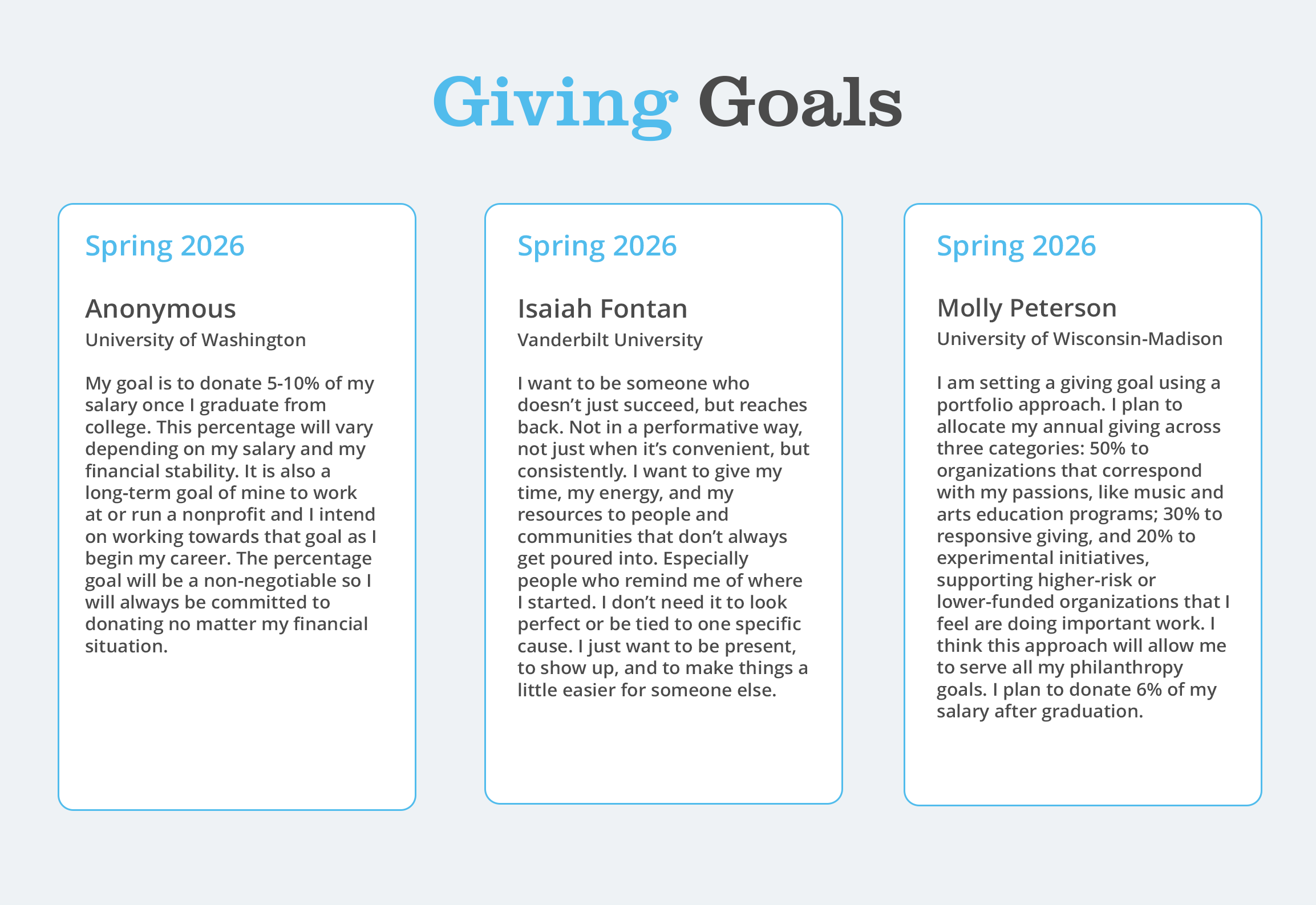
What is a Giving Goal?
Often, the idealism of youth is lost as one achieves success and acquires material possessions later in life. What was originally considered to be “enough” or even “beyond my wildest dreams” can become just another milestone on one’s quest…
Capturing your current vision of how you wish to give of yourself and your resources in the future could help you plan to give more meaningfully. Revisiting this vision in ten or twenty years could provide a reminder of the ideals of your youth that may shape or re-shape your future actions.
If you have already posted your Giving Goal and would like to update your email for future reminders, please contact [email protected]
Step 1
Have a healthy and vigorous dialogue in your class on the general idea of having a personal Giving Goal as a college student.
Step 2
Set a Giving Goal concerning your future giving plans.
Step 3
Share a brief statement of your Giving Goals on The Philanthropy Lab’s portal as a way to inspire others to do the same. You may post anonymously to the public if you wish.
Step 4
Share your permanent email address and phone number with The Philanthropy Lab, for the sole purpose of the reminder mechanism, so we can remind you of your goal in 5 year increments for 20 years into the future.
Alumni Reflections
Baylor Alum
"What a sweet reminder of this pledge! I've definitely given and volunteered in the last 6yrs. It's been a joy to continue the journey of generosity since graduating from undergrad. I'm back in grad school and I am looking forward to finishing my MSW. There will be new ways I give back to the community!"
Columbia Alum
"Thank you so much for this valuable reminder of my Giving Pledge. I'm proud to say I've dedicated several hours of volunteer time & services to Arts Education non-profits and will continue to live out this pledge"
Harvard Alum
“Thanks for reaching out––I'm actively still volunteering at two non-profits now in NYC (one free food service called "Wellfare" and a neighborhood homeless shelter)”
Wisconsin Alum
"Thank you for your email! The Philanthropy Lab was a life changing experience for me. I ended up joining the board of Malawi Children's Village to run the women empowerment program, which is what the Philanthropy Lab grant was for. In August, I am going to Malawi to see the project in action!"
UT Alum
"I was so happy to see this email pop into my inbox, it feels like a lifetime ago I was in this course. I appreciate all that I learned in this class and have taken its messages with me through these past 5 years. I do plan on maintaining the promise I made in this class"
Baylor Alum
"Thanks for this reminder. I actually still have a handwritten version of that note on the magnet board in my home office."
Search for Giving Goals
Over 4,200+ course participants have written giving goals in a demonstration of leadership!
Anonymous
- Fall
- 2024
I commit to volunteer once or twice a month with an organization I believe is creating positive change within my community. I commit to donating a minimum of $20 a month to the same or different organization and to remain a member of the Sierra Club by donating once a year.
Anonymous
- Fall
- 2024
After taking this class, I am more seriously considering the impact I want to have on those around me. While I do not have particular financial indicators that I want to follow, I know that I want to continue to be more intentional about how I donate my money and time. At least once a year, I want to take time out of my busy schedule to reflect on what organizations I want to support and what level my support should raise to.
Anonymous
- Fall
- 2024
Throughout my upbringing, I have always been raised to believe that your time and energy to do good is never wasted. As the saying goes in Arabic, ‘fiha khayr’ – “There is goodness in it’. I aspire to ground my philanthropy in unconditional goodness, harnessing the power of education to support underprivileged communities. I am deeply blessed and honored to join the giving pledge. As I grow older, I will intentionally ground my philanthropy to be sustainable and self-sustaining. With love, solidarity, and salam (peace), Lamis
Anonymous
- Fall
- 2024
This class has dismantled the notion to me that only certain elites, like Bill Gates, are “philanthropists,” thus instilling a preconceived notion that philanthropy is a convoluted and impersonal practice. What this class has done is, in fact, shown me that everyone can be a philanthropist, and the practice of philanthropy is not purely financial. Philanthropy is an active effort in your daily life to always be open to learning, expanding your perspectives, and giving your time and heart (and financial means) to a cause. This is my giving goal in life. That being said, my hope is that once I am financially independent, I can set a personal goal for myself to give away 10% of my salary. This is simply a bare minimum, a checks and balances for myself to ensure giving can and should always be a part of my life.
Anonymous
- Fall
- 2024
My giving goal surrounds evaluating and acting upon the ‘Post-Roe’ impact of reproductive/sexual healthcare access in areas of limited resources and geological accessibility (mostly southern/rural areas). I intend on advocating for efforts in aiding women in abortion-ban areas in travel expenses, using the class resources in an immediate fashion. I want to continue to search for a specific organization(s) that perform these services directly. My goal prioritizes women in areas/states in southern/rural areas for a variety of reasons, including the confirmation and reality that resources, exterior to access to affordable and necessary reproductive/sexual healthcare, are often curtailed. Examples include a drastic difference in minimum wage (abortion-ban states often have a lower minimum wage, matching the federal requirement of 7.25 dollars an hour), employment guarantees and benefits, a wider gender pay gap, etc. Direct objectives that do include or revolve around reproductive/sexual healthcare (and it’s accessibility level) and it’s variation in difference by states (often) along party lines encompass friendliness (or unfriendliness) in paid leave for pregnancies or parental/medical concerns, difference in education quality and substance, variations in affordable daycare or head-start resources, etc. For example, Louisiana, Oklahoma, and West Virginia are all total abortion ban states; they also all sit nearly at the bottom of state education rankings. I believe that my target prospective locations will include residents who require some form of reproductive/sexual healthcare in states with the farthest distance from a healthcare provider or center, such as a nearby (or closed possible) Planned Parenthood that provides the necessary services. These states will most likely include Texas, Louisiana, Mississippi, Alabama, and Oklahoma. The majority of residents in Texas, with the exception of 2-3 counties, who desire this specific type of healthcare must travel over 200 miles out-of-state. To conclude, my goal is, in short, to provide and aid women in states without convenient geographical and financial access to reproductive/sexual healthcare (primarily abortion travel expenses and Plan-B affordance) money and/or relief to travel/find/access these out-of-state providers. Long-term, I would be interested in seeing how these women, who successfully gained access to this healthcare through this class’ funding, transire professionally, academically, and personally, though I acknowledge this may violate personal patient confidentiality.