
After graduating, I plan to give 10% of my income away to primarily religious services. Beyond that I hope to spend time volunteering especially within healthcare and education services. This would be anywhere between 5-10 hours a week.

What is a Giving Goal?
Often, the idealism of youth is lost as one achieves success and acquires material possessions later in life. What was originally considered to be “enough” or even “beyond my wildest dreams” can become just another milestone on one’s quest…
Capturing your current vision of how you wish to give of yourself and your resources in the future could help you plan to give more meaningfully. Revisiting this vision in ten or twenty years could provide a reminder of the ideals of your youth that may shape or re-shape your future actions.
If you have already posted your Giving Goal and would like to update your email for future reminders, please contact [email protected]
Step 1
Have a healthy and vigorous dialogue in your class on the general idea of having a personal Giving Goal as a college student.
Step 2
Set a Giving Goal concerning your future giving plans.
Step 3
Share a brief statement of your Giving Goals on The Philanthropy Lab’s portal as a way to inspire others to do the same. You may post anonymously to the public if you wish.
Step 4
Share your permanent email address and phone number with The Philanthropy Lab, for the sole purpose of the reminder mechanism, so we can remind you of your goal in 5 year increments for 20 years into the future.
Alumni Reflections
Baylor Alum
"What a sweet reminder of this pledge! I've definitely given and volunteered in the last 6yrs. It's been a joy to continue the journey of generosity since graduating from undergrad. I'm back in grad school and I am looking forward to finishing my MSW. There will be new ways I give back to the community!"
Columbia Alum
"Thank you so much for this valuable reminder of my Giving Pledge. I'm proud to say I've dedicated several hours of volunteer time & services to Arts Education non-profits and will continue to live out this pledge"
Harvard Alum
“Thanks for reaching out––I'm actively still volunteering at two non-profits now in NYC (one free food service called "Wellfare" and a neighborhood homeless shelter)”
Wisconsin Alum
"Thank you for your email! The Philanthropy Lab was a life changing experience for me. I ended up joining the board of Malawi Children's Village to run the women empowerment program, which is what the Philanthropy Lab grant was for. In August, I am going to Malawi to see the project in action!"
UT Alum
"I was so happy to see this email pop into my inbox, it feels like a lifetime ago I was in this course. I appreciate all that I learned in this class and have taken its messages with me through these past 5 years. I do plan on maintaining the promise I made in this class"
Baylor Alum
"Thanks for this reminder. I actually still have a handwritten version of that note on the magnet board in my home office."
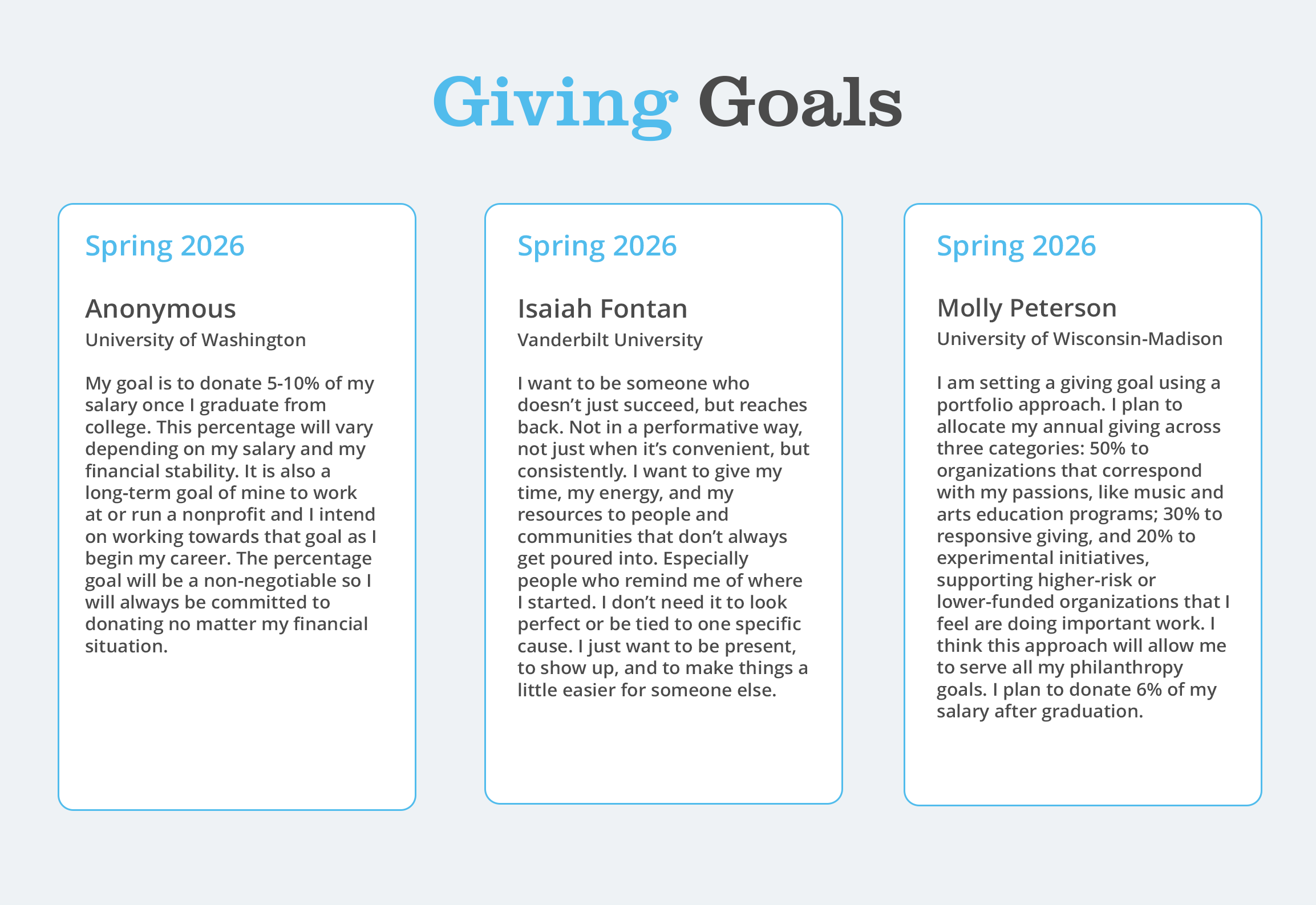
Search for Giving Goals
Over 4,200+ course participants have written giving goals in a demonstration of leadership!
Esai Almodovar
- Spring
- 2025
I plan on giving 10% of my income to charitable organizations.
Erica S
- Spring
- 2025
I’m not sure how much I want to give. After fully graduating, committing to donate at least $100 every year.
Erica Moser
- Spring
- 2025
My giving goal is to consistently donate 7-10% of my income and make a plan to redistribute some of my inherited wealth – or to at least reinvest it in less extractive systems, e.g. community loan funds instead of the stock market. To achieve this, I aim to devote time to researching what organizations best align with my values, while recognizing that what I consider the “best” organizations to support may be fluid based on politics and world affairs.
Erica Fleming-Hall
- Spring
- 2025
My giving goal for the future is multifaceted. I aim to contribute my time, money, and expertise to drive change and close gaps in education, housing, criminal justice, and health. The first aspect of this plan is to research the causal and correlated relationships between disparities in these areas. The second aspect is to collaborate with others, including community organizations, to identify modifiable risk factors and root causes of these disparities. After this, I plan to work within communities experiencing the highest levels of disparities to help mitigate identified risk factors and address root causes. This step will likely require all three of these resources and is the most scalable phase of the plan. The core of my giving goal is anchored in this phase, which is rooted in directly addressing disparities through action. My level of support will be aligned with my financial situation. Since I am graduating with a sizable student debt load, my initial financial contributions will be limited. However, I aim to gradually increase my giving to 20% of my discretionary income. My goal is to start by contributing a consistent recurring amount monthly and increase that amount as I can to a level that meets or exceeds 20% of my discretionary income. I am setting the goal to be proportionate to my discretionary income because the amount should increase as my discretionary expenses decrease. Similarly, I plan to increase my time commitment to reflect my available time, with a goal of eventually committing at least one day per week.