| University | Semester | Year | Course | Department | Instructor(s) | Students Enrolled |
|---|---|---|---|---|---|---|
| Stanford University | Spring | 2026 | Philanthropy for Sustainable Development | Political Science | Vera Michalchik, Patricia Bromley | 18 students |
| Stanford University | Spring | 2025 | Philanthropy for Sustainable Development | Political Science | Vera Michalchik, Patricia Bromley | 39 students |
| Stanford University | Spring | 2024 | Philanthropy for Sustainable Development | Political Science | Micah McElroy, Vera Michalchik | 27 students |
| Stanford University | Spring | 2023 | Ethical and Effective Philanthropy | Political Science | Vera Michalchik, Patricia Bromley | 30 students |
| Stanford University | Spring | 2022 | Theories of Civil Society, Philanthropy, and the Nonprofit Sector | Political Science | Bruce Sievers | 30 students |
| Stanford University | Spring | 2020 | Theories of Civil Society, Philanthropy, and the Nonprofit Sector | Political Science | Bruce Sievers | 22 students |
| Stanford University | Spring | 2019 | Theories of Civil Society, Philanthropy, and the Nonprofit Sector | Political Science / Honors – Ethics in Society | Bruce Sievers | 25 students |
| Stanford University | Spring | 2018 | Theories of Civil Society, Philanthropy, and the Nonprofit Sector | Political Science / Honors – Ethics in Society | Bruce Sievers | 24 students |
| Stanford University | Spring | 2017 | Theories of Civil Society, Philanthropy, and the Nonprofit Sector | Political Science | Bruce Sievers | 22 students |
| Stanford University | Spring | 2016 | Theories of Civil Society, Philanthropy, and the Nonprofit Sector | Political Science | Bruce Sievers | 18 students |
| Stanford University | Spring | 2015 | Theories of Civil Society, Philanthropy, and the Nonprofit Sector | Political Science | Bruce Sievers | 21 students |
| Stanford University | Spring | 2014 | Theories of Civil Society, Philanthropy, and the Nonprofit Sector | Political Science | Bruce Sievers | 18 students |
| Stanford University | Spring | 2013 | Theories of Civil Society, Philanthropy, and the Nonprofit Sector | Political Science | Bruce Sievers | 20 students |
| Stanford University | Spring | 2012 | Theories of Civil Society, Philanthropy, and the Nonprofit Sector | Political Science | Bruce Sievers | 21 students |

Theories of Civil Society, Philanthropy, and the Nonporofit Sector
Taught by Patricia Bromley & Vera Michalchik
Department of Political Science, Honors Ethics in Society
Vera Michalchik leads PACS’s research on effective philanthropy and the design of materials, institutes, and consultations for donors, advisors, and others wanting to put into practice principles that can advance impact in the sector. She brings to her role extensive experience in social science research, the learning sciences, and strategic philanthropy, having worked in research-plus-practice positions at SRI International’s Center for Technology in Learning, the Gordon and Betty Moore Foundation, UC Irvine’s Department of Informatics, and Stanford’s Center for Teaching and Learning. She also built a library system on a small island in Micronesia while collecting data there for her dissertation on how knowledge gets managed for social good. She holds a PhD from Stanford, EdM from Harvard, and BA from UC Berkeley—her studies all focused on learning, media, and shaping of cultural norms.

Casey Toohill – Stanford Philanthropy Lab student – Spring 2018
Selected an organization he was introduced to through the class as his NFL charitable commitment.
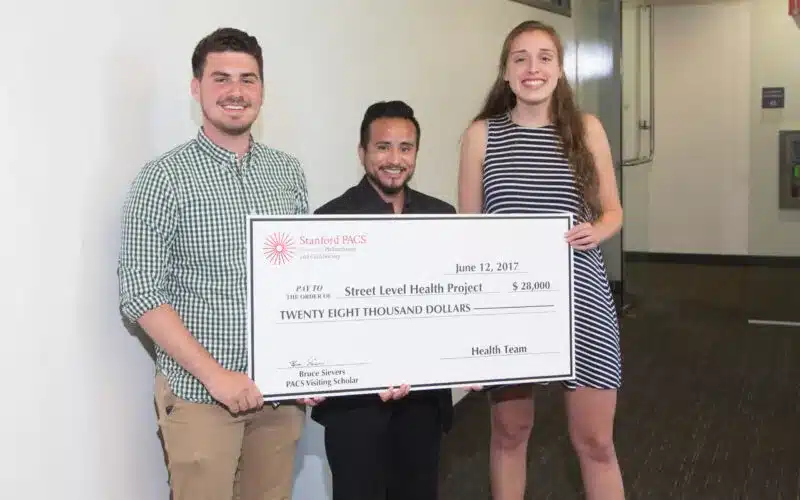
“I was approached with the opportunity to partner with an organization called “Pledge It” that works with the NFL combine. I first learned about Hospitality House when doing research for a Stanford class called “Theories and Practices of Civil Society, Philanthropy, and the Nonprofit Sector”. I was part of a group that was tasked with providing a grant to a charitable organization of our choosing. Our team was focused on health and one of our group members had knowledge of Hospitality House and the work that it was doing in the Tenderloin area of San Francisco. After visiting Hospitality House and speaking with its Executive Director Joe Wilson our group decided that Hospitality House was special. It was so much more than a shelter, and looked at the health of its residents in a holistic manner.”
Unique Course Components
- Groups pitch nonprofit based on internet research and virtual site visits
- Each team does a 3-minute pitch for their org with time for Q&A on Pitch Day
- Each team does another pitch for their org with time for Q&A on Deliberation Day
- Potential to give only 1 large grant
- Course offered in the School of Sustainability, with giving for sustainability defined very broadly, and multi-disciplinary input, including from faculty and staff at Stanford’s Center on Philanthropy and Civil Society
- Students complete an online module called “Build a Theory of Change”
- Students go through the different scenarios in the module then present their choices to the class. They also send to Paul Brest before he speaks to the class
- Guest Speaker: Paul Brest, Former President of the Hewlett Foundation and former Dean of Stanford Law School, author of Money Well Spent
Guest Speakers
- Previous student representatives who went to the Philanthropy Lab’s Ambassadors Conference
- Speaker from the Haas Center for Public Service
- Paul Brest (author of “Money Well Spent,” previous president of Hewlett Fdtn, and dean of Stanford Law School)