

Philanthropy Lab GrantWriting Board alum Nicole M. Foldi Martinez recently presented a poster session about her GWB experience at AMCL’s Institute of Asset Management Global Conference 2025. Nicole wrote three grants for Sociedad de AmbienteMarino (SAM), a marine conservation nonprofit in Puerto Rico.
Introduction
In Puerto Rico, many environmental nonprofit organizations (NGOs) rely on volunteer participation to complete restoration andconservation projects. Volunteer efforts have shown to be effective in restoring vulnerable marine ecosystems like coral reefs (Hesley et al., 2017). A significant portion of these volunteers are undergraduate students, which in turn gain field experience in the NGO’sarea of expertise. However, under the current economic crisis, sustaining these projects which provide volunteering opportunities canbechallenging. Marine habitat restoration work is expensive, with an average cost of $1,600,000 USD (in 2010) for each hectare of marine coastal habitat restored (Bayraktarovet al., 2016). Adjusted for current inflation, this number rises to $2,330,931.50 USD. Federal grants have been a major funding source for these restoration projects in Puerto Rico. However, under the current political climate, these are predicted to become scarce (Gerrard, 2024). Therefore, in addition to field experience, environmental marine NGOs should also focus on educating undergraduate students in the philanthropic sphere to secure funding for their organization. Financial education is very needed in the third sector as only 4.5% of Puerto Rican NGOs have both local and federal tax exemptions, limiting funding opportunities for most local NGOs (EstudiosTecnicosInc, 2022). This proposed arrangement benefits NGOs by increasing funding opportunities and sources. The participating students acquire in-demand skills and learn about the third sector which benefits their future career prospects. This poster highlights an example of this arrangement, the grants that were submitted and gives suggestions for future projects.
From Philanthropy Lab to Sociedad de AmbienteMarino (SAM)
In Spring 2023, I joined the pioneer Philanthropy Lab course at Universidad del Sagrado Corazón in Puerto Rico, a hands-on program where students manage real grant funding to support local nonprofits. Our class was entrusted with $50,000, divided between two committees. My group awarded grants to impactful organizations such as Fondo Accesoa la Justicia, Arte y Maña, and Solo Por Hoy. These projects provided legal aid, promoted art education, and supported the homeless, respectively. Seeing the real-world impact of our decisions, such as helping 300 seniors avoid eviction and supporting over 2,000 community members through arts and services, cemented mypassion for strategic philanthropy.
Following the course, I was selected to join the Philanthropy Lab’s GrantwritingBoard. This opportunity allowed me to partner with Sociedad de AmbienteMarino (SAM), a marine conservation nonprofit that aligns with my academic focus in marine biology. Through the program’s mentorship and access to professional grant platforms, I collaborated on the submission of three grant proposals and gained practical experience in nonprofit development and funding strategy.
Pure Ocean Challenge 2024

The first grant which we collaborated on was the Pure Ocean Challenge Grant for 2024. It provided awardees with a maximum of $80,000 for a project that spanned two years. I found this opportunity on Instrumentl, a platform specialized in connecting nonprofits with funding opportunities. The grant was sponsored by the Pure Ocean nonprofit. This French organization sponsors international research projects to better protect and understand ocean ecosystems. The structure of the grant was a series of 45 sections you had to fill out on the website, with sections spanning between a paragraph and two sentences. The title of the grant we submitted was: Comparing materials used for 3D coral restoration of Diploriastrigosaat Culebra, Puerto Rico. Through this project, we wanted to study the effect of growing Diplorastrigosawith molds made up of two different types of materials, plastic and lactic acid based. Unfortunately, we did not receive this grant. However, my work uncovered a potential future funding source and introduced SAM to this organization.
Coastal Habitat Restoration and Resilience Grants for Tribes and Underserved Communities NOAA 2023
This is the second grant we submitted, and it was more ambitious than the one before. It followed the standard NOAA format, with sections of Project Summary, Project Narrative, Budget Narrative and Supplemental Materials, making it much more structured and lengthier than the previous grant. Awardees of this grant would receive up to 3,000,000 for projects with a length of 2 to 3 years. Involving 8 marine restoration groups and 5 different coral restoration across Puerto Rico, the MARES (Mobilizing Alliances to Restore Ecosystem Services) project aimed to unify local marine environmental groups, build capacity in local vulnerable communities and restore 5acres of coral reef with 25,000 fragments around Puerto Rico. These efforts sought to protect coastal communities against climate change effects such as flooding and provide them training to enhance their economic opportunities. Unfortunately, we were not awarded the grant, although it did rank high in the score it received from the selection committee. However, this project also helped establish the next grant we submitted.
Transformational Habitat Restoration and Coastal Resilience NOAA 2025
After the evaluation of the first MARES project by NOAA, we improved upon the points mentioned and developed MARES 2.0. This project we submitted it under the Transformational Habitat Restoration and Coastal Resilience Grants, which awards selected projects up to $8,000,000. Like the previous project, it followed the same structure to complete it. Once again, the project intends to unite local environmental organizations to engage in widespread ecological restoration. This time the goal is to restore a total of 63.01acres of coastal habitat across 9 sites, distributed between coral reefs (6 acres), mangroves (22.15 acres), seagrasses (3.17 acres), and sanddunes (31.69 acres). This would be achieved with a collaboration of nine partner organizations which include academia, private businesses andenvironmental nonprofits. Since this project was submitted in April 2025, we are still waiting to know if it will be selected. This would represent a huge impact on the ecological vitality of Puerto Rico’s coastal regions and an immense opportunity to build local capacity around ecological restoration.

Suggestions to Involve Undergraduates in Grant Writing
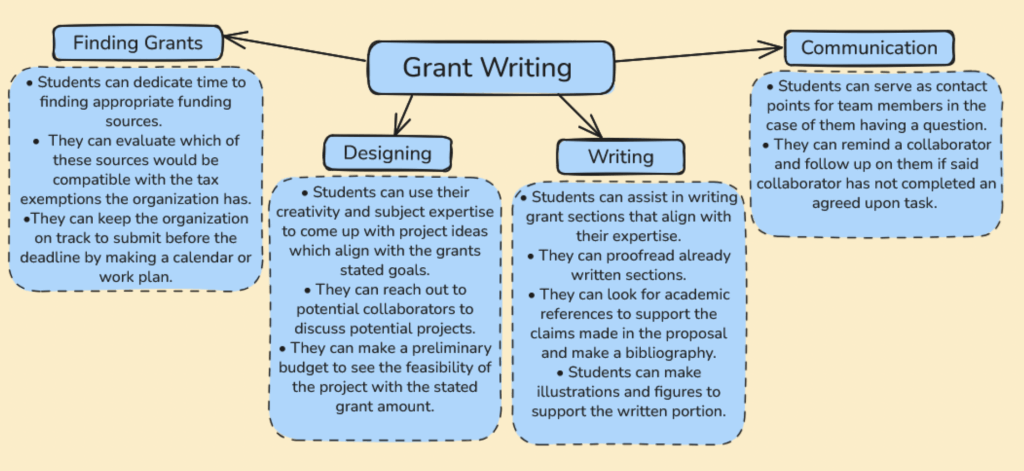
Based on my experience, below are some ways in which undergraduate students can contribute to the process of grant writing:
Conclusion
Aiding in the process of selecting grants, designing projects and writing has been very beneficial to my professional development as a marine scientist. It expanded my knowledge on tropical marine ecosystem and their services, the current challenges these face, and how to incorporate this into grant writing. My contributions to the projects included writing primarily for the Project Narrative section, connecting partners in the collaborative projects, drafting letters of support, and finding relevant references to include in the project. These skills will help me as I move to my graduate program. This experience has motivated me to become certified in the future as a professional grant writer.
Article by Nicole M. Foldi, 2023 Universidad del Sagrado Corazón Philanthropy Lab alumnus and GrantWriting Board participant


