This post was originally written by authors Kristen Valdiviez and Tommy Rosenow on 5/21/2026
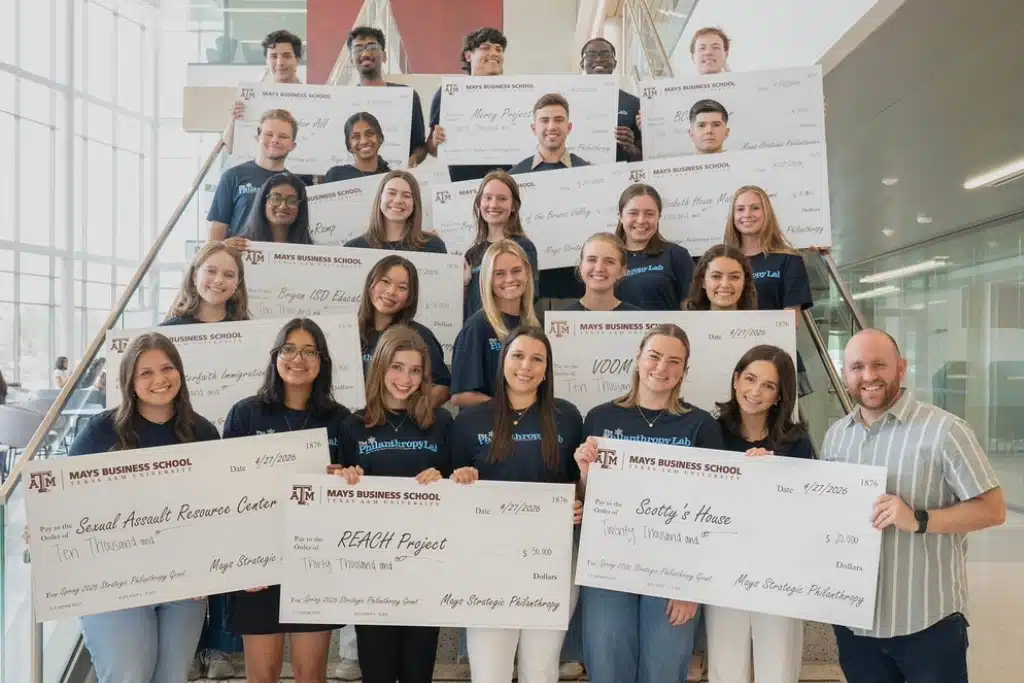
In our final semester at TCU, Tommy and I were part of a class called Giving & Philanthropy. Led by Dr. Ron Pitcock, 18 students were entrusted with allocating $100,000 to up to five nonprofits in Tarrant County.
Throughout the semester, we reflected on what it meant to “do good.” This simple question proved to be far more challenging than we first perceived. To do good, we also had to answer another question: for whom are we responsible? These questions guided and challenged us as we delved into complex conversations like: How do you compare 100,000 meals to cancer support? Hearing aids for children to foster care services? Homelessness alleviation to mentorship programs?
We quickly realized that philanthropy may begin with generosity, but giving well requires much more than good intentions. It requires a balance of the head and the heart, along with discernment, stewardship, humility, and perspective.
We are grateful for the generosity of the Kelly & Jeff Dillard Family Foundation, Jay and Karen Case, and The Philanthropy Lab, who made this learning experience possible.
Below are the biggest lessons this experience taught us.
1. Every Donation Has an Opportunity Cost
One of the hardest truths we learned was that saying yes to one worthy cause meant saying no to another.
Our resources of time, talent, and treasure are finite. Volunteering for one cause means that time is not spent elsewhere. Giving to one organization means those dollars cannot also be given to another. Every nonprofit we researched in this class was doing meaningful work, which made the decisions even harder.
The weight of that opportunity cost can sometimes lead us to act purely out of emotion. And while having a heart for a cause can guide us, it cannot be our only motivation.
Throughout the class, we learned about several famous failures of philanthropy. In many of those cases, the donor genuinely wanted to do good. But good intentions were not enough. Without careful thought, humility, and attention to possible consequences, even generosity can create outcomes no one intended.
That challenged the way we thought about giving. A personal connection, emotional story, or urgent need may make one cause feel more compelling, but that does not automatically mean it is the wisest use of limited resources.
A grounding idea throughout our final debate was impact. We knew that some of the most important outcomes of philanthropy cannot be fully measured by numbers: dignity, self-sufficiency, belonging, hope. But we also had to think practically. What could this amount of money actually make possible? Could it help HOPE Farm purchase transportation? Could it provide hearing aids through Be An Angel? Could it fund counseling sessions, meals, mentorship, housing support, or medical care?
Those questions helped us move from emotion alone toward responsible decision-making. We were not just asking which causes mattered. We were asking where our gift could create meaningful, thoughtful, and measurable impact. Opportunity cost did not make the decision less compassionate; it made the responsibility clearer. It forced us to recognize that giving well requires both caring deeply and choosing wisely.
2. Business Skills Matter Deeply in Nonprofits
As Tommy and I both studied Finance at TCU, we spent the past four years learning what makes organizations run well: strategy, cash flow management, marketing, leadership, and financial sustainability. We learned that running any organization is complicated.
Giving & Philanthropy taught us that these skills are not only useful in the corporate world; they are deeply important in the nonprofit sector too.
Before this class, we subconsciously viewed nonprofits as separate from business. We knew they had missions, donors, programs, and people to serve, but we did not understand how much operational excellence it takes to sustain that work. Nonprofits still must pay staff, manage cash flow, build trust with donors, measure impact, communicate their missions, and make strategic decisions with limited resources.
One resource that especially challenged my thinking was the documentary Uncharitable. It pushed back against an assumption I did not realize I had: that the “best” nonprofits are the ones that spend the least on overhead. But throughout the semester, we began to see how limiting that mindset can be. If donors constantly reward nonprofits for keeping administrative costs as low as possible, nonprofits can be forced to underinvest in the very things that help organizations run well, such as talented employees, technology, marketing, fundraising, strategy, training, and long-term planning.
In business, we understand that strong organizations require investment. Companies pay competitive salaries, build infrastructure, advertise, hire skilled leaders, and spend money to grow. Yet in the nonprofit world, those same expenses are often viewed with suspicion.
This realization felt especially relevant as Tommy and I prepare to enter the field of finance, where compensation is often seen as a natural reward for skill, long hours, and responsibility. Meanwhile, many people working in nonprofits are addressing some of the hardest problems in our community, and we expect them to do it for far less. It made us wonder: if nonprofits were allowed to function more like strong organizations instead of constantly proving how little they spend on themselves, could they serve people better?
This does not mean nonprofits should spend carelessly. Stewardship still matters deeply. But good stewardship is not the same thing as spending as little as possible. Sometimes, responsible giving means supporting the infrastructure that allows a nonprofit to sustain and grow its impact.
3. Site Visits Changed Everything
Reading about a nonprofit is one thing, but walking through its doors brings the whole operation to life.
The final phase of this class involved conducting site visits with the organizations in our final 15. By that point, we had already completed two rounds of debate and narrowed the list down from more than 70 nonprofits originally considered. We thought we understood the organizations well. And in some ways, we did. We had read their websites, briefing documents, and financials, but nothing compared to seeing the work firsthand.
One thing that stood out was the deep care the staff members had for their missions. Their work did not seem driven by obligation, but by love—love for the people they serve and a resilience to keep showing up for them. Across the nonprofits we visited, there was a clear sense that this was not just a job; it was a calling.
For me, this became especially clear during our visit to HOPE Farm. That visit made the reality of life in Morningside, Fort Worth feel much closer. HOPE Farm’s mission is to help break the cycle of fatherlessness in boys’ lives through after-school programming, mentorship, meals, transportation, and consistent adult presence. Seeing the space and meeting some of the boys they serve helped me understand that their work is not just about programming; it is about creating stability, belonging, and hope.
For Tommy, the visit to Christ’s Haven stood out. When our group arrived at the site, we didn’t see a walled-in compound for children in foster care. Instead, we saw a thriving neighborhood, no different than the ones surrounding the area. There was a pond, expansive green spaces, a horse pen, and several houses along with the administrative building. By visiting Christ’s Haven, we got to see firsthand how the staff and volunteers have created a community and family where children can experience stability, belonging, and care.
These site visits also showed us how interconnected the nonprofit community in Tarrant County is. Many of the organizations we visited were not operating in isolation. They knew one another, referred clients to one another, and understood where their work fit into the larger ecosystem of need. They were not competing for clients. They were each addressing different parts of deeply connected problems.
And so we learned that due diligence cannot simply happen from behind a computer. Go meet the people who have given their lives to a cause. Listen to them. Learn from them. Encourage them. And when you can, support them generously.

4. Mission Alone Isn’t Enough
Nearly every nonprofit we encountered in the class was trying to do something genuinely good. The difficult question was not whether a cause mattered, but whether the organization could steward resources effectively.
On the first day of class, we were shown three nonprofits and given only a few minutes to evaluate them based solely on their websites and promotional material.
Almost everyone in the class was drawn toward one nonprofit focused on helping children. The videos were emotional, the stories were compelling, and the branding was polished. Another organization, focused on supporting firefighters, had an outdated website that was harder to navigate and lacked clear messaging. Most of us put it at the bottom of the list.
Then Dr. Pitcock revealed something surprising: the nonprofit we were most emotionally drawn toward had been ranked among the worst nonprofits in America due to concerns surrounding fundraising practices and executive compensation.
That exercise exposed something important: a compelling mission, emotional storytelling, or polished marketing does not necessarily mean an organization is operating wisely or effectively. Likewise, a weaker presentation does not mean an organization lacks integrity or impact. In some cases, limited marketing may simply reflect that more resources are being directed toward programming.
This class taught us to look beyond the mission statement. Leadership, stewardship, organizational culture, transparency, execution, and long-term impact all matter deeply. And while a good cause is important, mission alone is not enough.
5. Giving Is More Than Money
The first assignment in our class was deceptively simple: we were each given $10 with the instruction to “do good.”
For days, we overthought how to maximize it. I ended up donating online to a nonprofit I had volunteered with before, but Tommy took a more creative approach.
He and a friend combined their money into a total of $20 and decided to visit a local elderly care center. They bought flowers and Bibles, then spent two hours with the residents dancing to Elvis and Johnny Cash, listening to stories, playing games, and sharing their faith.
By the end of the day, Tommy realized that the $20 was only part of what they gave. The real gift was the time, attention, and memories shared with the residents.
After spending a semester helping allocate $100,000 to nonprofits, one of the clearest lessons we took away was that generosity is not always measured by scale. Sometimes the most meaningful form of giving is simply sharing life with other people.
Money matters. It funds programs, pays staff, keeps lights on, and expands capacity. But money is not the only thing we have to give.
We can give time. We can give attention. We can give encouragement. We can give skills. We can give presence. That realization made philanthropy feel much more personal and much more possible.
6. You Don’t Have to Be Wealthy to Be Generous
It is easy to view philanthropy as something reserved for people with substantial wealth. The assumed timeline usually goes something like this: work hard, save money, build a career, and maybe give later. But when is later? And when do you have “enough” to begin giving back?
This class taught us that giving is more of a habit and mindset than an aspirational goal.
One idea that challenged our assumptions was giving circles. Giving circles are groups of people who pool their resources together to create meaningful impact collectively. In some ways, our class functioned like one, even though the money was not our own. Eighteen students, each with different backgrounds, perspectives, and causes we cared about, came together to thoughtfully allocate a shared pool of resources.
The idea of giving circles reframed philanthropy for us. It showed us that generosity is not reserved for billionaires or large foundations. In fact, according to Giving USA, individual donors consistently account for roughly two-thirds of charitable giving in America.
Meaningful giving often happens through people contributing what they can, where they can, alongside others.
This class taught us that generosity is less about reaching a certain income level and more about developing a habit of stewardship, service, and intentionality with whatever you already have.
7. Business Can Be a Vehicle for Good
Before taking this class, it was easy to treat our future careers and our desire to give back as two separate categories.
As we progressed through college, we sometimes wondered what it meant to pursue business as a vocation. It is not always easy to feel deeply passionate about maximizing shareholder value, forecasting future cash flows, or presenting a new product strategy.
However, this class helped us see business differently. Many of the essential skills of a good business leader—analysis, communication, creativity, ethics, leadership, and decision-making—can be used to do good.
We are grateful to know now that the dozens of presentations, spreadsheets, projects, and case studies we completed over the past four years were not just for a grade or a diploma. They helped build skills that can serve people.
If you are skilled at Excel modeling, you can help a local nonprofit budget and forecast its revenues and expenses. If you are gifted in sales, you can fundraise for a cause you care about. If you are a strong communicator, you can help an organization tell its story more clearly. If you are a compelling writer, you can help draft grants, donor letters, or impact reports.
But this lesson goes beyond skills-based volunteering. It also changed how we think about work itself. Not everyone has to quit a well-paying job and start a nonprofit to do good. For many people, doing good may look like encouraging a coworker, mentoring someone on your team, serving on a board, volunteering consistently, giving generously, or using your professional network to support organizations already doing meaningful work.
As Dr. Pitcock often asked us: “For whom are you responsible?”
Conclusion
This class changed the way we think about giving.
We entered the semester thinking philanthropy was mostly about generosity. We left understanding that generosity is only the beginning. Giving well requires wisdom, responsibility, humility, and courage.
It means asking harder questions than, “Is this a good cause?” It means asking: Did we do good? How do we know? And for whom are we responsible?
We may never answer those questions perfectly. But we learned that giving well begins with being willing to wrestle with them.
Each student dedicated one class period to someone who had deeply impacted them. These dedications reminded us that philanthropy is personal. Before discussing nonprofits, financials, and funding decisions, we were reminded of the people, experiences, and values that shaped how we thought about giving. It helped keep our work grounded in what mattered most.
Who has shaped the way you think about giving? And how can you honor their impact through the way you live, serve, and give?
Giving away $100,000 was a rare opportunity. One lasting gift this class gave us was the realization that philanthropy is not something we have to wait decades to practice. We can begin now — with our money, time, skills, attention, and relationships.
Because generosity is not just something we do when we have more. It is a way we choose to live with what we already have.

References
Giving USA Foundation. (2025). Giving USA 2025: The annual report on philanthropy for the year 2024. Giving USA Foundation. https://givingusa.org
See original article here.